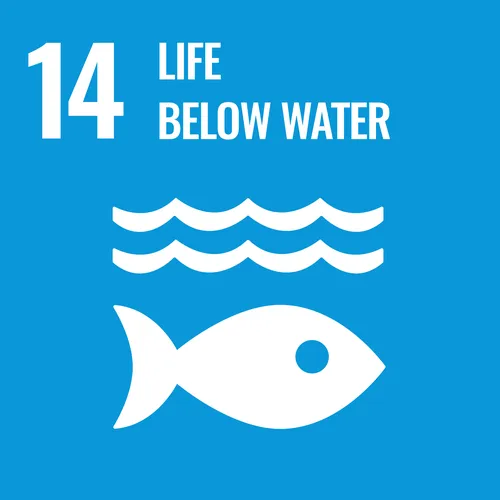
See all 17 Sustainable Development Goals - SDGs
What is SDG 14 Life below water about?
Conserve and sustainably use the oceans, seas and marine resources for sustainable development.
Oceans and seas cover more than 70% of our planet. They support life for many plants and creatures, including humans. We rely on these huge bodies of water for water, food and energy.
Many of the world’s waterways are suffering from pollution and overfishing. We need to look after them, and the marine life that grows in and on them, by regenerating, protecting and managing them responsibly.
What can a business do to influence SDG 14?
To make progress on SDG 14, businesses need to manage how they use oceans, seas and marine resources, and how their operations affect them.
How to make progress with SDG 14
- Use resources efficiently
- Track the life cycle of products and materials to see what happens during production and at the end of their life to see what can end up in the marine environments
- Replace, limit or prohibit the use of certain chemicals, additives, or materials that could lead to nutrient pollution or chemical and physical hazards in marine ecosystems
- Consider changing the design or how a product and its packaging are made and used to reduce the amount of waste that could potentially end up in oceans and waterways
- Raise consumer awareness on effective ways to properly dispose of their waste to discourage littering and promote responsible behaviour
- Consider how you can use less clean water.
- Reduce activities that cause oceans to acidify
- Fish sustainably and refrain from practices that put marine species and resources at further risk of harm, exploitation or deletion.
- Conserve coastal and marine areas
How businesses can benefit
- Reduce environmental and regulatory risks
- Reduce costs
- Build brand and reputation
- Strengthen relationships with local communities (social licence to operate)
- Attract, engage and retain talented team members
Examples
New Zealand seafood supplier Sealord is more aware than many companies that waste degrades marine waterways. Sealord is reducing plastic wrapping and polystyrene across its supply chain in the products it buys and the products it produces. Read more here: Sealord’s sustainability work.
FoodCap International has designed an end-to-end logistics system based on circular economy to store and transport fish and seafood between harvesting and processing. The packaging is a lightweight, durable foamed resin and 100% recyclable. It can be reused many times instead of the single-use EPS (Expanded Polystyrene/Styro) packaging common across the industry that contaminates the marine food chain. Read more here: FoodCap’s logistics system for fish and seafood
New Zealand Avocado carried out a Life Cycle Assessment (LCA) to understand how the nutrients their growers use affect waterways, including those that flow to the sea. It is now working to minimise adverse impacts. Read more here: New Zealand Avocado’s Life Cycle Assessment (LCA produced by the New Zealand Life Cycle Management Centre).
Talk with our expert
Martin Fryer
Head of Strategy & Disclosures
Our SDG expert Martin Fryer has spent his career helping businesses succeed sustainably. His expertise includes running SDG workshops, setting sustainability strategy, targets and KPIs, measuring impact and reporting.
Martin is also an expert in managing carbon emissions, climate-related risk, energy-efficiency and minimising waste. He is a Chartered Environmentalist with an MBA.
You may also be interested in
Sustainability strategy
Confirm a structured, practical plan to make progress on your chosen SDGs. Your stakeholders and your business will thank you!
Sustainability reporting
Understand how to use the SDGs to provide context for your sustainability reporting.