Australia has big news on embodied carbon. At its June meeting, the country's Building Ministers agreed to include a voluntary pathway in the National Construction Code (NCC) 2025 for commercial buildings to measure and report on embodied carbon. So what is embodied carbon and why is it so important?
What is embodied carbon?
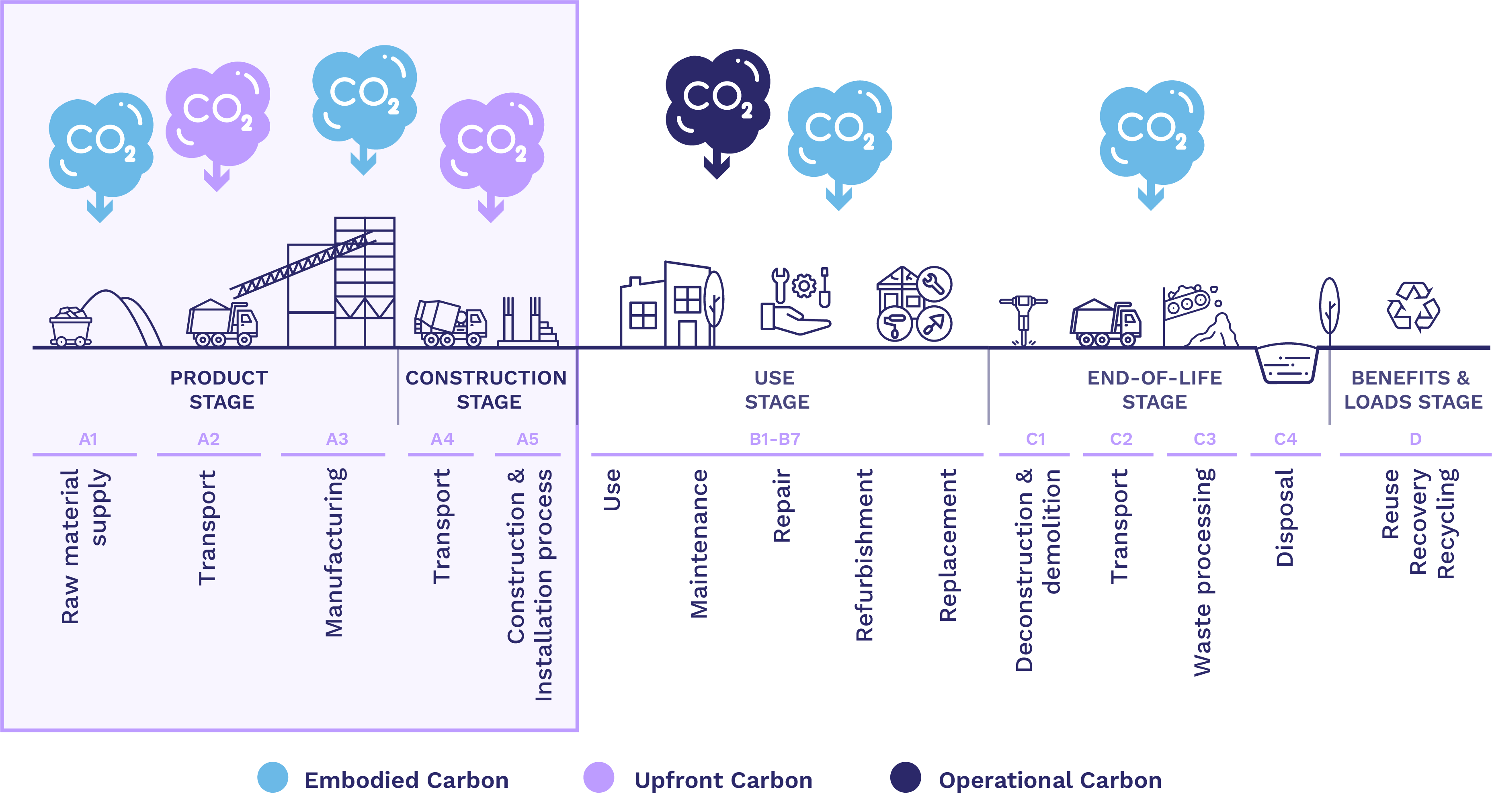
Carbon emissions from buildings and infrastructure come from two main sources:
→ Operational emissions
Associated with using an asset. They come mainly from using electricity and fossil fuels (natural gas, LPG, diesel, coal, etc.).
→ Embodied emissions
Associated with constructing and maintaining an asset, as well as treating waste at the end of the asset’s life. Upfront emissions are those embodied emissions that happen before the asset is in use.
 Source: thinkstep-anz
Why are we talking about embodied carbon now?
To tackle the built environment’s impacts on climate change, we need to reduce all carbon emissions across the whole life of a building or an infrastructure asset. We know that we can reduce operational emissions by making assets more energy-efficient and by decarbonising the electricity grid. However, embodied carbon is harder to abate, and we still have a lot to learn.
→ Emissions becoming locked in
Buildings and assets have long service lives. Most of what we build today has a service life of more than 50 years and will part of the zero-carbon world of 2050 that we are committed to.
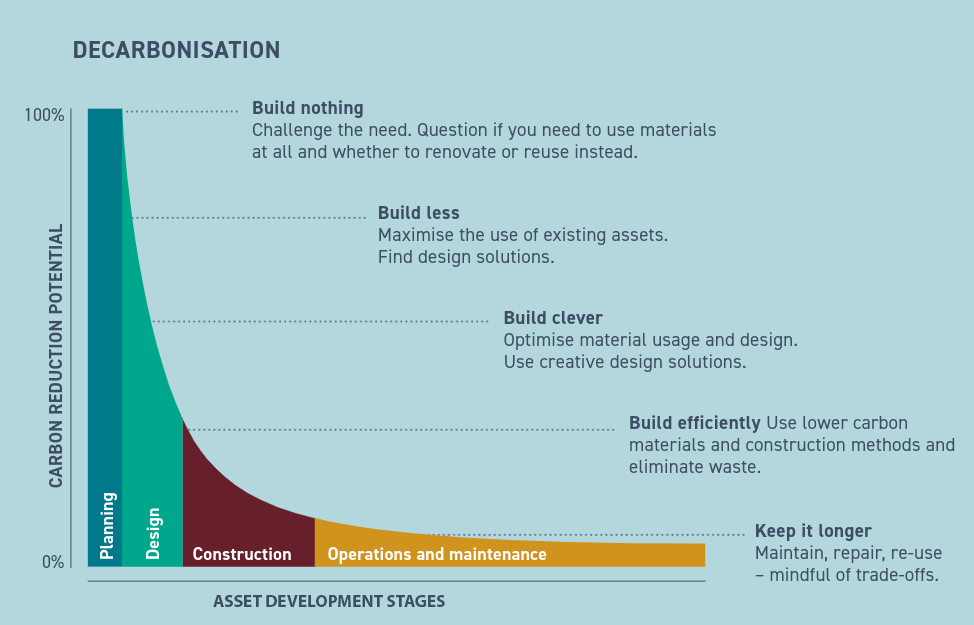
While some operational carbon emissions can be reduced over time, for example through decarbonisation of the energy grid, upfront embodied carbon is ‘locked in’ before the asset is used.
To reduce embodied carbon in new infrastructure and buildings we need to change how we plan, design, procure and deliver. We have to act now to cut carbon over the whole life of an asset.
Source: thinkstep-anz based on HM Treasury Infrastructure Carbon Review, 2013
A brief history of thinkstep-anz’s embodied carbon work
The earliest life cycle assessments (LCAs) for buildings were undertaken in the 1990s. The first international standards for Environmental Product Declarations (EPDs) followed in 2007.
2011 saw the publication of EN 15978, a European standard for conducting life cycle assessment on buildings. While this defined common rules for building LCAs that are still used today, this standard didn’t include the word ’embodied’.
In 2014, our CEO Barbara Nebel – in her role as President of the Life Cycle Association of New Zealand (LCANZ) – initiated EPD Australasia as a joint venture between LCANZ and the Australasian Life Cycle Assessment Society (ALCAS), with initial seed funding from LCANZ, the Heavy Engineering Research Association (HERA) and the Building Research Association of New Zealand (BRANZ).
2015 saw the publication of the first 12 Environmental Product Declarations (EPDs) for products manufactured in Australasia via EPD Australasia, working together with the International EPD System in Sweden. Early adopters included Allied Concrete, David Trubridge, BlueScope Steel and Forest & Wood Products Australia (FWPA).
In 2017, New Zealand’s Productivity Commission released figures suggesting the built environment’s carbon footprint sits between two and five percent of the country’s carbon emissions. This didn’t sound right to our Technical Director Jeff Vickers. The Intergovernmental Panel on Climate Change and the United Nations Environment Programme had put the building sector’s carbon footprint at between 19 and 33 per cent of global emissions. We asked: Can the carbon footprint of New Zealand’s built environment really be so different to the rest of the world?
We set out to crunch the numbers
We allocated emissions to where products are consumed, rather than where they are produced and we considered the entire life cycle of buildings, from extracting raw materials to the building's energy use and treating construction waste.
Looking at emissions this way, the share climbed to 20% (with embodied carbon at 9%) – which identifies the built environment as a hotspot in New Zealand’s national carbon footprint. Published in our 2019 report, Hotspot or not? The carbon footprint of NZ's built environment, this figure included the embodied carbon in both buildings and infrastructure.
This 20% figure was included in the New Zealand Government’s Building for Climate Change programme in 2020 via the publication of MBIE’s Whole-of-Life Embodied Carbon Emissions Reduction Framework. An updated calculation that excluded embodied carbon in Infrastructure can also be found in Aotearoa New Zealand’s first Emissions Reduction Plan from 2022.
Time to tackle that hotspot
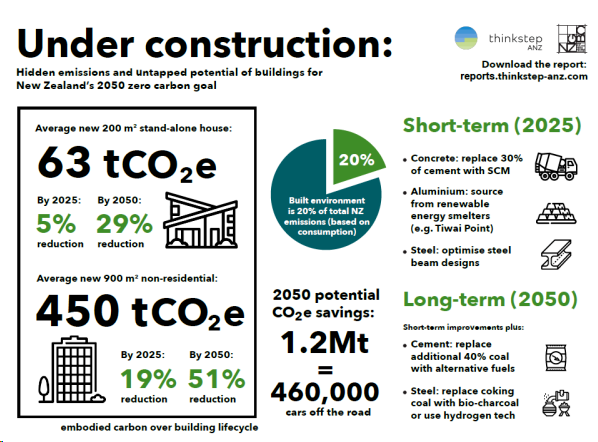
We followed up with a joint report with the New Zealand Green Building Council in 2019. This report – Under construction: hidden emissions and untapped potential of buildings for New Zealand’s 2050 zero carbon goal – identified opportunities to decarbonise New Zealand’s building and construction sector by 40%, with a focus on embodied emissions, between 2019 and 2050.
 Source: thinkstep-anz
Finding partners to increase our impact
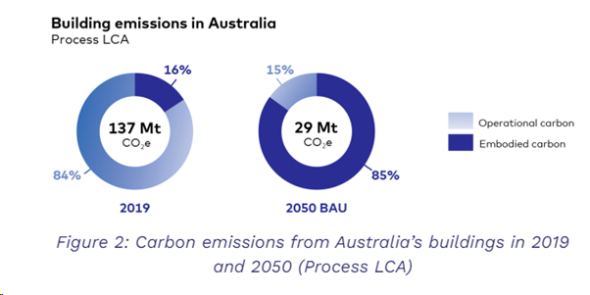
Our Impact Director Nicole Sullivan joined thinkstep-anz in 2020 and brought extensive expertise in engineering, sustainability and marketing. Together with the Green Building Council Australia (GBCA), Jeff Vickers and Nicole led the report Embodied Carbon & Embodied Energy in Australia’s Buildings in 2021. It highlights the increasing significance of embodied carbon and embodied energy in the building sector’s carbon footprint. The report compares a 2019 baseline year to a 2050 business-as-usual scenario to show what could happen without deliberate action on embodied emissions.
It shows that without action embodied emissions could form 85 percent of the total carbon emissions of Australian buildings by 2050, from a baseline of 16 percent in 2019.
The report emphasised the urgency of tackling embodied carbon, particularly upfront emissions.
 Source: GBCA and thinkstep-anz
Embodied carbon becomes part of ratings
Before joining thinkstep-anz, Nicole led embodied carbon developments at the GBCA. In 2019, the GBCA announced that buildings would have to reduce their upfront carbon emissions to achieve a rating. Green Star Buildings (released in 2020) was the first rating tool to require that all buildings be built with 10% less upfront carbon than a ‘reference building’ of the same type.
Helping industry measure and reduce
Spurred by the growing awareness of embodied carbon, industry has been asking for a way to measure and reduce its footprint.
Between 2021 and 2023, we worked with the New Zealand Green Building Council and industry to produce the Green Star Embodied Carbon Calculator. The calculator provides a consistent approach to calculate upfront carbon and whole-of-life embodied carbon.
We also worked closely with the GBCA and the National Australian Built Environment Rating System (NABERS) to provide consistency on both sides of the Tasman.
In 2022, addressing the need for national benchmarks, NABERS, with the GBCA's support, announced that they are developing a NABERS Embodied Carbon standard. This program of work will establish an agreed national method for measurement.
Where are we now with embodied carbon?
In June 2024 NABERS released a national emission factors database we helped to develop. It includes data from EPDs for more than 2,500 products. This valuable resource will provide consistency across reporting on embodied carbon emissions in the built environment.
The database will be integrated with the upcoming NABERS Embodied Carbon tool, currently in its pilot phase. This tool will enable new buildings and major refurbishments to measure, verify, and compare their upfront embodied carbon with similar buildings.
Also in June 2024, the Australian Sustainable Built Environment Council (ASBEC) released an Issues Paper we worked on. The paper Embodied Carbon Emissions in Australia’s Built Environment gathers stakeholder insights on upfront embodied carbon policy options for Australia’s built environment with the goal of delivering a comprehensive policy framework later this year. The issues are presented as seven decarbonisation dilemmas. They are problems that must be solved first to build momentum so that other changes can follow. Stakeholders are invited to respond to a survey on the issues described in the paper by 26 July 2024.
In July 2024, Infrastructure Australia released its Embodied Carbon Projections for Australian Infrastructure and Buildings. This report calculates upfront carbon across buildings and infrastructure in Australia for the 2022-23 financial year and considers near-term decarbonisation strategies out to 2026-27 for Australia’s future pipeline of buildings and infrastructure. Importantly, the report identifies that over 20% of upfront carbon emissions can be eliminated within this time horizon for no cost at the national level.
Combined skills to tackle embodied carbon
We have come a long way in the last decade. We are proud to play a part in shaping how embodied carbon is being measured and reduced on both sides of the Tasman. Working with industry and creating certainty for what is possible and expected will lay the foundations for the rapid action we need. We are also helping many manufacturers and industry associations to measure, publish (in an EPD) and reduce their embodied carbon.
There’s still a lot to do and we’ll continue to combine our LCA, EPD, carbon and circular economy expertise with our strategy and industry knowledge to help governments, ratings agencies, industries and companies tackle embodied carbon.