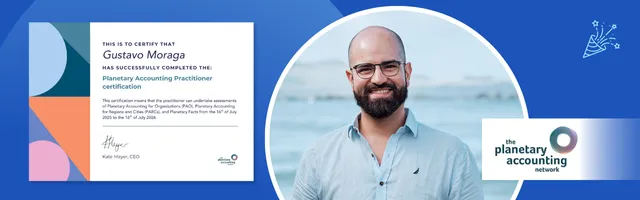
This certification builds on our long-standing involvement with the Planetary Accounting Network and strengthens our expertise in science-based decision-making. It equips Gustavo – and our wider team – with practical tools to help clients align their strategies with the Earth’s environmental limits.
What is Planetary Accounting?
Planetary Accounting translates global environmental limits – known as the Planetary Boundaries – into measurable budgets. These boundaries cover nine key systems that regulate the stability of our planet, including climate change, biodiversity loss, freshwater use, and chemical pollution.
By applying these measurable budgets, Planetary Accounting makes it possible to connect global science with everyday decisions. The framework can be used at any scale, from guiding individuals and businesses to shaping government policy.
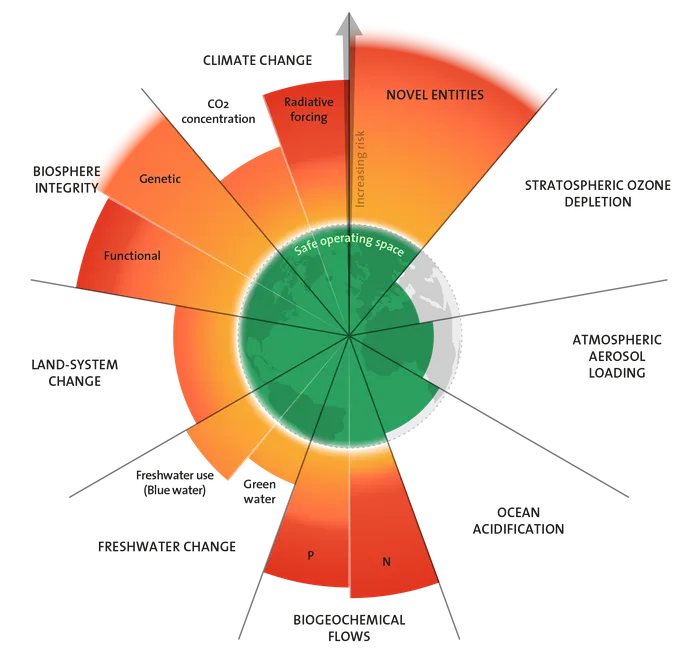
Image source: https://www.stockholmresilience.org/research/planetary-boundaries.html
Gustavo’s perspective
We asked Gustavo what he values about Planetary Accounting, what he learned through the certification, and how it can benefit businesses.
What do you value about Planetary Accounting?
“It gives a clear, science-based way to understand Planetary Boundaries and link them to local and organisational decisions. The Planetary Facts tool is also excellent for transparent communication of impacts.”
What did you take away from the course?
“A practical framework to measure impacts across all Planetary Boundaries, not just climate change, and confidence to explain them in a way businesses can act on.”
How can businesses benefit?
“Planetary Accounting makes environmental impacts straightforward to understand. It helps identify risks and opportunities, supports clear communication and reduces the risk of greenwashing.”
Why this matters for businesses
Sustainability is not just about reducing carbon emissions. Organisations need to consider the full range of environmental pressures – from land use to nutrient flows – if they want to future-proof their operations and maintain credibility. Planetary Accounting provides a transparent, science-based framework that helps businesses:
- understand and measure their environmental impacts
- identify material risks and opportunities
- communicate clearly with stakeholders
- avoid greenwashing by grounding actions in science.
How we can help
With Gustavo now accredited, thinkstep-anz is even better placed to help businesses connect global environmental science with local decisions. It’s a step that strengthens our ability to guide clients towards strategies that are good for business – and good for the planet.