Not long ago, Santa made headlines in the North Pole and beyond. After centuries of operating without formal reporting, she finally tackled climate-related disclosures using disclosurekit™, proving that even seasonal icons need to consider ESG topics to stay on top of their game.
The Easter Bunny read the story. She finished her carrot tea. And then she had a thought.
If Santa can do climate disclosure… maybe I should figure out what actually matters in the Easter operation. After all, delivering billions of eggs and chocolate treats around the world every year is not exactly a small business.
After hopping around in circles for a while, the Easter Bunny gave thinkstep-anz a call. We suggested what we usually do when organisations are not sure where to begin: start with a materiality assessment.
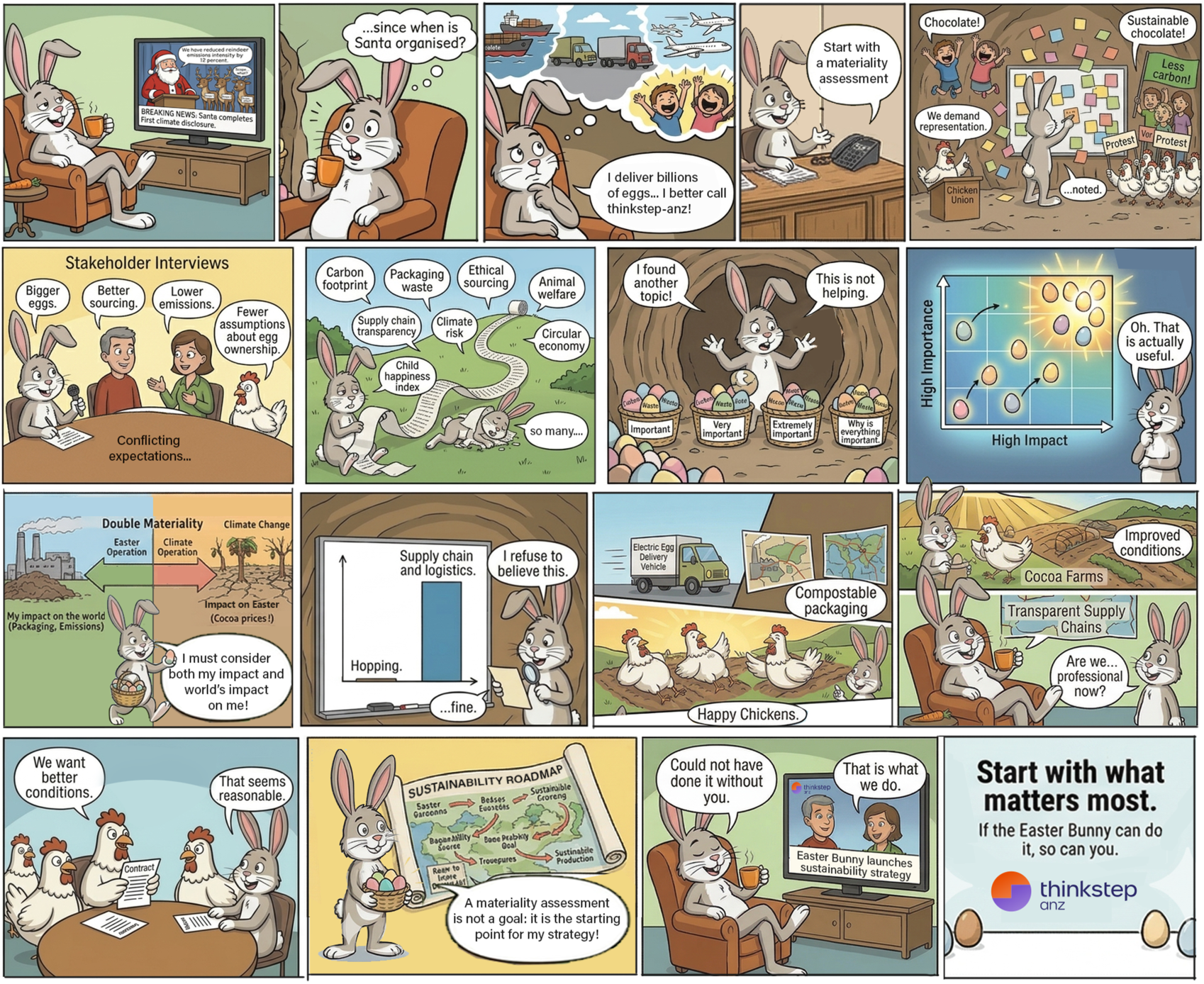
Step 1: Start with the big question
The first step in a materiality assessment is understanding why you are doing it.
The Easter Bunny’s strategic question was simple:
How can the Easter operation deliver joy to millions of children (and adults!) while reducing environmental impact and keeping the egg supply chain responsible?
A materiality assessment helps organisations identify and prioritise the environmental, social, governance and economic topics that matter most to their business and stakeholders.
In other words, it helps answer a very practical question:
Where should we focus our effort to make the biggest difference?
For the Bunny, the goal was not just to understand sustainability risks. It was also to identify opportunities to improve how Easter works for everyone involved. Because chocolate eggs should bring joy, not supply chain headaches.
Step 2: Identify stakeholders
No organisation operates in isolation. The same goes for any rabbit responsible for global chocolate egg logistics. A materiality assessment includes engaging with stakeholders, both inside and outside the organisation, to understand what they think is important.
When the Easter Bunny began mapping his stakeholders, the list turned out to be longer than expected.
External stakeholders
-
Children (primary egg recipients and joy auditors)
-
Parents (budget controllers and chocolate regulators)
-
Chocolate manufacturers
-
Cocoa farmers and egg suppliers
-
Retailers and distributors
-
Logistics partners
-
Environmental groups
-
The global chicken community
Internal stakeholders
-
The Easter Bunny
- Santa (seasonal icon peer)
-
Assistant bunnies
-
Procurement and basket manufacturing teams
-
The Egg Logistics and Seasonal Operations team
The Bunny gathered input through surveys, interviews and a few lively stakeholder workshops.
-
Children prioritised maximum chocolate density.
-
Parents prioritised ethical sourcing and sustainability.
-
Environmental groups prioritised carbon reduction and responsible sourcing.
-
Chickens submitted a strongly worded letter regarding egg ownership rights.
Step 3: Identify potential material topics
Next, the Bunny compiled a long list of sustainability topics that could affect the Easter operation. This included reviewing stakeholder input, looking at industry expectations and examining the Bunny’s own operations.
The long list included topics such as:
-
Responsible procurement of cocoa and eggs
-
Carbon footprint of global egg deliveries
-
Sustainable packaging for Easter baskets
-
Animal welfare in egg supply chains
-
Waste from foil wrappers
-
Climate risks to cocoa production
-
Supply chain transparency
-
Child happiness index (a key seasonal KPI)
At this stage, the goal is not to prioritise yet. It is simply to identify everything that could matter. Or, as the Bunny put it: get all the eggs in one basket before deciding which ones really matter.
Step 4: Prioritise topics using a materiality matrix
Once the topics were on the table, it was time to separate the critical eggs from the decorative ones. Materiality assessments typically evaluate topics based on two dimensions:
-
How important they are to stakeholders
-
How much they affect the business
These results are often visualised in a materiality matrix, which helps organisations see which topics are most critical.
In the Bunny’s case, several topics hopped straight into the top right corner of the matrix:
-
Responsible procurement
-
Ethical cocoa sourcing
-
Carbon footprint of deliveries
-
Sustainable packaging
-
Animal welfare in egg supply chains
-
Supply chain transparency
-
Child happiness
These topics scored highly both because stakeholders cared deeply about them and because they directly affect the Easter operation.
But the Bunny did not stop there. She also looked at the issues through the lens of double materiality. This means looking at sustainability in two directions:
-
How the Easter operation affects the environment and society
-
How environmental and social changes could affect the Easter operation from a financial point of view
For example:
-
Delivering billions of eggs and chocolate treats has an environmental impact, from packaging waste to supply chain emissions.
-
At the same time, issues like climate change affecting cocoa production could affect Easter itself due to increased prices for cocoa.
Looking at both sides helped the Bunny understand not only his impact on the world, but also the risks the changing world might pose to his egg delivery operation.
In other words, it was not just about protecting the planet. It was also about protecting Easter and the happiness of millions of children.
Step 5: Taking action: Understanding the carbon footprint
Once the material topics were clear, the Bunny moved to the next step: taking action based on the results.
Carbon emissions emerged as one of the most material topics. So the Bunny started with the most practical first step: understanding the carbon footprint of the operation.
Because you cannot manage what you do not measure, the Bunny began with a spend-based estimate of scope 3 emissions, using spend-based emission factors to estimate the impact of:
-
Chocolate purchases
-
Packaging materials
-
Logistics and transport
-
Basket manufacturing
Spend-based calculations are often used as a starting point because they are quick and give organisations a good initial picture of their emissions hotspots.
The results confirmed what many suspected: The biggest emissions drivers were supply chains and logistics, not the Bunny’s hopping. This insight helped the Bunny understand where action would have the greatest impact.
Step 6: Taking action: Responsible procurement
Responsible procurement also ranked highly in the materiality assessment. This makes sense. Most of the Easter Bunny’s environmental and social impacts occur in the supply chain, not in the burrow (that’s for relaxing, once the works is done).
So the Bunny began developing a responsible procurement strategy based on the material topics identified.
This included reviewing suppliers and asking questions such as:
-
Are cocoa beans sourced responsibly?
-
Are chickens treated well?
-
Are suppliers aligned with sustainability expectations?
-
Are there risks in the supply chain that could affect Easter in the future?
The Bunny also started engaging suppliers to improve practices across the supply chain. Because if the cocoa supply is not sustainable, there will eventually be no chocolate eggs. And that would be a global crisis.
Step 7: Taking action: Building the roadmap
With the key issues identified through the materiality assessment, the Bunny could now move from analysis to strategy. The materiality assessment helped answer the most important question: Where should the Easter operation focus first?
Based on the results, the Bunny began developing a sustainability roadmap focused on the most material topics.
Key priorities include:
-
Reducing emissions across the egg delivery operation
-
Improving responsible sourcing of cocoa and eggs
-
Reducing packaging waste
-
Increasing supply chain transparency
-
Supporting more sustainable production practices
This roadmap helps the Bunny move from understanding the issues to taking practical action. Because a materiality assessment is not the end goal: It is the starting point for a sustainability strategy.
The good news
Many organisations are asking the same questions as the Easter Bunny.
-
What matters most?
-
Where should we focus first?
-
And how do we turn sustainability ambitions into a clear strategy?
Materiality assessments are often the first step. They help organisations understand their impacts, engage stakeholders and prioritise action. And if the Easter Bunny can start her sustainability journey, any organisation can.
At thinkstep-anz, we help organisations do exactly that – from materiality assessments to carbon footprints, responsible procurement and sustainability roadmaps.
Even if your supply chain does not involve billions of chocolate eggs.
Although we would happily help with that too.