A festive tale of governance, reindeer methane and planning for a resilient Christmas
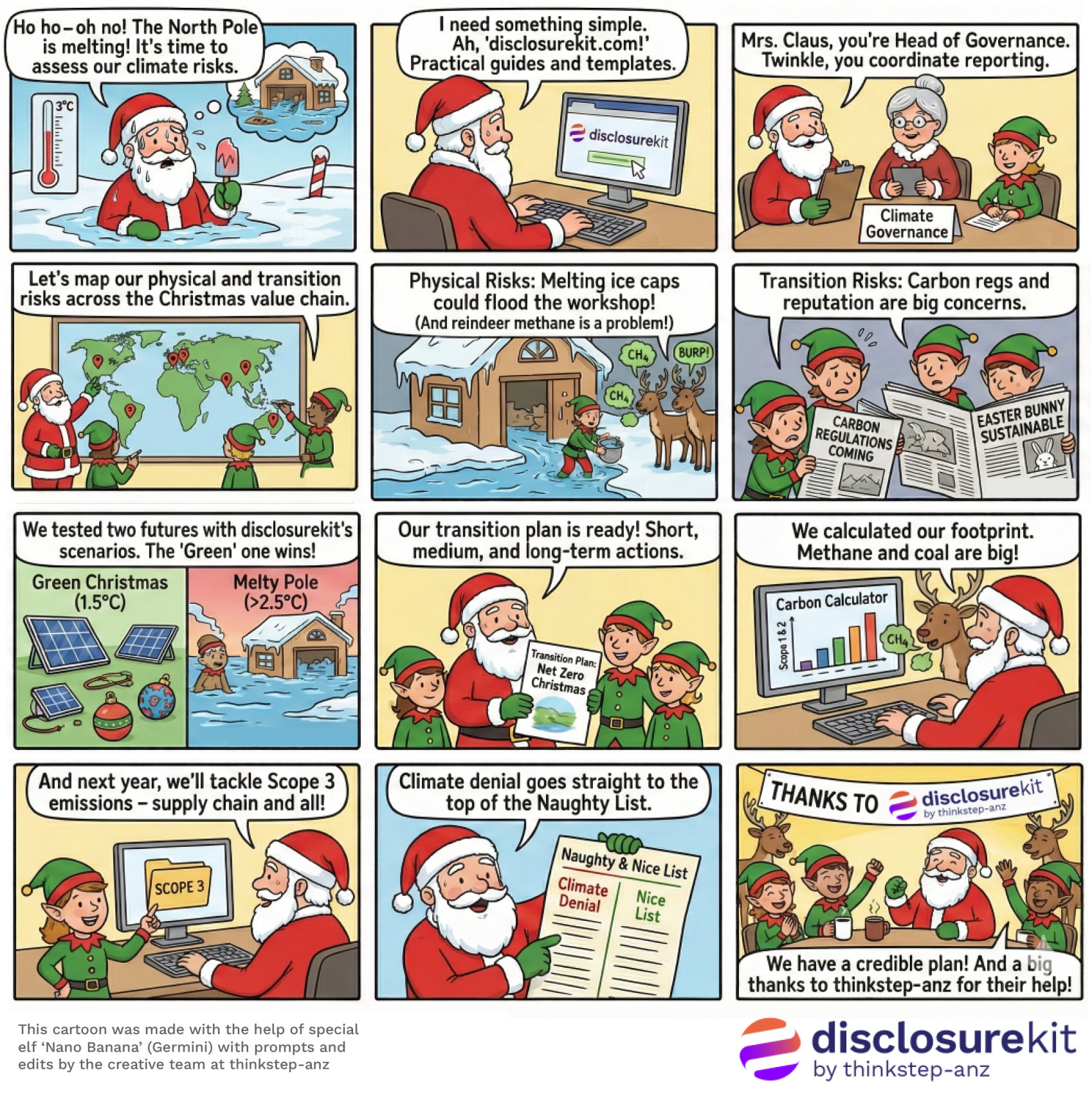
It started one frosty morning at the North Pole, when the thermometer hit a record high of 3°C. The snow on the reindeer runway turned to slush, and the candy cane factory’s cooling system started to sweat. “Ho, ho - oh no,” said Santa. “It’s time to assess our climate risks.”
Santa knew he needed help. He searched for something simple that would guide him through the work without creating more chaos in the workshop. That is when he discovered disclosurekit™ - a practical system with guides and templates designed to help organisations understand their climate risks and plan for the future. It guides the North Pole team through the pillars of governance, strategy, risk management and metrics and targets.
“It even works at the North Pole,” said Twinkle the Sustainability Elf. “Perfect.”
Step 1: Sorting out Christmas governance
Santa starts by setting up clear governance so the North Pole team knows who is responsible for climate decisions. Mrs Claus leads climate oversight as Head of Governance, while Twinkle coordinates reporting and keeps the action log tidy.
Santa reviews climate risks as part of his regular Naughty & Nice oversight cycle. This structure makes sure climate is embedded into decisions about toy production, energy use and long-term planning.
They create a RACI matrix to make sure all is under controlled.
|
Task |
Responsible |
Accountable |
Consulted |
Informed |
|
Calculating Santa’s carbon footprint |
Twinkle (Sustainability Elf) |
Mrs Claus |
Rudolph (methane data), Chief Engineer Elf (boiler logs) |
Santa |
|
Assessing physical climate risks (melting snow, storm delays) |
Elf Operations Team |
Head of Reindeer Operations |
Dasher & Dancer (flight conditions) |
Santa, Mrs Claus |
|
Running scenario analysis (“Green Christmas” vs “Melty Pole”) |
Twinkle |
Mrs Claus |
Chief Weather Elf, Reindeer Operations, Toy Logistics |
Santa |
|
Approving the transition plan (“Net Zero Christmas”) |
Santa |
Santa |
Mrs Claus, Elf Council |
All elves |
|
Managing reindeer methane reduction strategy |
Reindeer Nutrition Elf |
Head of Reindeer Operations |
Rudolph (pilot participant), Vet Elf |
Santa, Toy Delivery Crew |
Step 2: Understanding the risks (and spotting opportunities)
The team gathered around Twinkle’s climate maps and began identifying where climate change was already affecting their work. Together, they mapped out physical and transition risks across the Christmas value chain.
Physical risks:
- Melting ice caps: The North Pole workshop and sleigh garage are at risk of flooding.
- Extreme weather: More storms could disrupt toy deliveries and reindeer flight paths.
- Heat stress on reindeer: Dasher and Dancer are hardy, but 20°C summers aren’t in their contract.
Transition risks:
- Carbon regulations: Increased emissions from making toys could lead to a “Coalition for a Sustainable Christmas” asking Santa to report his carbon footprint.
- Reputation: If Santa doesn’t act, he might lose the holiday market share to the Easter bunny who is sustainably sourcing her fair-trade chocolate eggs.
- Energy costs: The Elf Energy Grid still runs partly on coal from the Naughty List Mines (a problem Santa has been ignoring).
But not everything was doom and gloom. The elves spotted several climate opportunities: switching to renewable energy, reusing toy parts, strengthening Santa’s brand with a credible plan, and partnering with sustainable reindeer feed suppliers to reduce methane.
Opportunities:
- Efficiency: Introducing modular toy designs that can snap apart and be reassembled allows elves to customise gifts quickly and reduce material use.
- Reputation and brand: A transparent “Net Zero Christmas” plan could secure Santa’s social licence for generations to come.
- New partnerships: Collaborating with renewable reindeer feed suppliers could reduce methane and open new “green gift” markets.
Step 3: Testing Christmas against two climate futures
With disclosurekit’s templates helping them to run internal workshops, Santa’s team tested their strategy against two plausible futures.
Scenario 1 – 1.5°C (the Green Christmas scenario):
Global action is strong. Renewable energy powers most toy factories, flight paths are coordinated to minimise emissions and children start requesting second-hand toys and digital experiences as their preferred gifts. The North Pole remains cold enough to operate year-round, but adaptation is still needed.
What this means:
- Opportunities outweigh risks.
- Santa must invest early in clean tech (solar panels, wind turbines, and an e-sleigh prototype - we crunched some numbers on this too).
- The Elves’ R&D Lab can launch the “Circular Toy Initiative” to reuse materials from previous years.
Scenario 2 – >2.5°C (the Melty Pole scenario):
Global efforts falter. Sea ice retreats rapidly, and the reindeer paddock turns into a muddy pond. Extreme weather events cause delays, while supply chains break down due to heatwaves in toy part factories.
What this means:
- Physical risks dominate.
- Santa’s North Pole base becomes partly uninhabitable by 2040.
- Costs skyrocket as Santa must relocate production to climate-resilient regions (like Finland or Antarctica’s higher plains).
- Insurance premiums for sleigh damage rise faster than the Christmas Eve delivery schedule.
Using these scenarios, the team stress-tested every part of their operation. They identified which activities were vulnerable (like cold storage and logistics) and which were resilient (digital gift lists, 3D printing, and renewable toy production).
Step 4: Building Santa’s transition plan
Santa knew he needed to take decisive action — not just for compliance, but to future-proof the joy of Christmas. With clearer insights and structured templates from disclosurekit, Santa and his leadership elves created a Transition Plan for a Resilient Christmas, covering short-, medium-, and long-term actions.
Short-term (1–3 years):
- Conduct a full carbon inventory of the North Pole (scope 1–3, of course).
- Begin staff training on sustainable toy-making and energy efficiency.
- Launch “Project Silent Night,” replacing coal heating with geothermal warmth from deep under the ice.
Medium-term (3–10 years):
- Transition to circular toy production - every toy returned or broken is refurbished into new gifts.
- Retrofit the main workshop to withstand melting permafrost and extreme winds.
- Engage suppliers in climate action through the “Elf Code of Sustainable Conduct.”
Long-term (10+ years):
- Establish regional toy-making centers closer to children to reduce raw material transport emissions and increase resilience through a diversified supply chain.
- Offset residual emissions through verified reforestation - planting “Christmas Trees for All.”
- Relocate vulnerable North Pole operations to Iceland as it’s remote and they have geothermal energy sources.
- Continue annual scenario analysis to adapt to new conditions and maintain resilience.
Step 5: Santa calculates his carbon footprint
Santa knew that a credible transition plan needed more than good intentions. He also had to disclose his carbon footprint. With Twinkle’s help, he opened the disclosurekit carbon calculator to work out his emissions for the year.
They started with the essentials:
Scope 1 emissions: methane from rudolph and his fellow reindeer, coal for workshop boilers to keep the place warm and LPG for the fleet of forklifts.
Scope 2 emissions: electricity used across the workshops, reindeer barns and wrapping hall.
The calculator made the process simple. Santa loaded in his activity data - from fuel invoices to electricity statements - and disclosurekit converted it into clear, easy-to-read results.
Twinkle reminded him that scope 3 emissions would be on the horizon soon. These covered everything from toy materials, packaging and waste. Santa made a note to prepare for it next year, once the elves had improved their data collection.
|
GHG emissions (million tonnes of CO₂e) |
2025 |
|
Scope 1 emissions |
1.733 |
|
Scope 2 emissions (location-based) |
5.197 |
|
Total Scope 1 + 2 emissions |
6.930 |
DISCLAIMER: Please note: this is a fictional example as Santa was not able to use the disclosurekit carbon calculator as it does not currently support North Pole-specific emission factors. In reality, he engaged thinkstep-anz to calculate the carbon footprint on his behalf.
Santa’s reflection
At the close of the workshop, Santa smiled and updated his Naughty & Nice list: climate denial went straight to the top. “Scenario analysis showed me not what to fear,” he said, “but how to prepare.”
Twinkle updated everything using disclosurekit’s templates so the team could track progress easily (and be ready for assurance). The elves celebrated with oat-milk cocoa, proud that Christmas now had a clear and credible net zero transition plan.