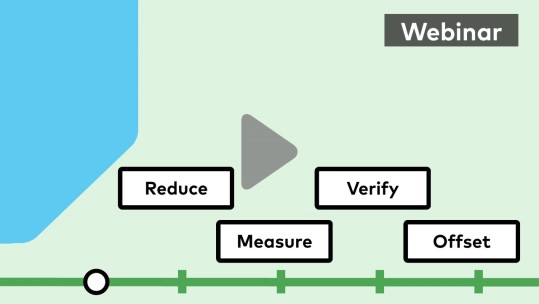
‘Carbon: all aboard! Navigating the reduction & offset network’ was recorded as part of thinkstep-anz’s ‘Straight from the horse’s mouth’ webinar series. Here is the highlights tour.
A smaller footprint starts with reduction and measurement
Every carbon offsetting journey should start with reduction and measurement. Buy a lifetime pass because this is not a one-time journey. It should always be reassessed to find opportunities to reduce where you can and track overall progress. Once reduction and measurement are properly addressed, it is time to move on to the first transfer – the verification line. This line is only required if your destination is certification. Verification can look different between organisations under the Ekos programme, based on the size of their footprints.
Environmental Product Declarations – a shortcut to product verification
Verification should not be confused with another stop in the reduction and measurement line: Environmental Product Declarations (EPDs). These are always separate from the previous step as they involves independent assessment. EPDs can speed up the verification process.
An EPD is an internationally recognised, third-party verified document that communicates the environmental impact of a product by reporting on a wide range of environmental indicators. An EPD includes a carbon footprint with all EPDs carried out under the Australasian EPD Programme being recognised by a range of offsetting programs including Climate Active in Australia (formerly NCOS). An organisation with an existing Australasian EPD can save both time and money in their journey to become carbon neutral as it eliminates the need for carbon footprint calculation and the subsequent verification process.
Read more about EPDs here.
The offset line
Measurement and reduction of your carbon footprint should make up the majority of your carbon strategy – but even with substantial effort and investment in emissions reduction you will very likely still have a residual carbon footprint. This is because the marginal cost of emissions reduction escalates rapidly after you have harvested the low hanging fruit – emissions reductions below the carbon price threshold per tCO2e.
This is the ideal time to catch a transfer onto the offset train. But what exactly is a carbon offset? Sean Weaver defines each carbon offset as a metric ton of CO2e that has either been removed from the atmosphere (carbon sequestration) or has been kept out of the atmosphere (reduced/avoided emissions).
Carbon offsetting enables you to harvest the equivalent volume of emissions reduction as the high (prohibitively expensive) fruit but where these emissions reductions occur outside your business boundary. By purchasing carbon offsets, you are paying someone else to harvest the low hanging fruit on their emission reduction tree. These carbon offsets come from projects that reduce or avoid emissions, and which are certified to a carbon standard. Reforestation carbon projects are examples of this – projects that remove carbon from the atmosphere and store it in new permanent forests. Note that a tree may only live for a few hundred years, but a permanent forest can live for many thousands of years.
Buying carbon credits alone is not considered an offset – the credits must also be cancelled in a recognised carbon registry. This completes the offset as the carbon units are officially 'consumed' and unable to be purchases by others.
Carbon strategy
A carbon strategy should prioritise reduction and measurement, but carbon offsetting has a key part to play in every individual business strategy. Moreover, offsetting helps to finance emission reductions across the economy, and when arising from projects that involve permanent reforestation, can contribute to climate resilience in rural landscapes.
Carbon offsetting is not ‘just a license to pollute’. Voluntary carbon offsets compensate for legal emission sources (use of electricity, driving, waste, freight, flights). As such these ‘licenses to pollute’ already exist. Voluntary carbon offsetting and zero carbon certification provide an opportunity to go the extra mile and take responsibility for the emissions you could not reduce in-house.
A final step is to be transparent about what you have done by accurately communicating your carbon footprint, reduction effort, and offsetting actions to your stakeholders.
With a team of experts spread throughout New Zealand and Australia, thinkstep-anz is a 100% locally owned, B-Corp organisation that specialises in sustainability services including product and corporate carbon footprints, measurement and reduction plans, and carbon reduction strategies.
Ekos is an offsetting expert that focuses on supply of high-quality forest carbon credits, zero carbon certification and carbon footprint measurement and reduction plans.