By Martin Fryer, Head of Strategy and Disclosures, thinkstep-anz
August 2026
Reporting obligations can change faster than the underlying risks and there appears to be an ever-increasing reporting burden. Investors want useful information, and boards need to understand how risks may affect strategy, assets and financial performance. Organisations that have produced sustainability disclosures have also set an expectation of transparency. Stepping back or creating complex and weighty reports can weaken trust.
Treat disclosure work as business planning
The value of any sustainability disclosure lies in the work behind it: identifying risks and opportunities, testing their financial implications, deciding who is responsible and tracking what changes over time. That work belongs in business and financial planning, not in a document that comes together once a year.
Many organisations have completed a materiality assessment and a climate-related risk and opportunity assessment through separate projects. They may now be considering nature-related dependencies and impacts, or emerging approaches to social and inequality-related reporting. The information grows while the links remain hard to see.
Integration becomes much easier when each piece of work uses familiar business structures. Governance, strategy, risk management and metrics and targets already underpin Aotearoa New Zealand Climate Standards. The Taskforce on Nature-related Financial Disclosures uses a similar structure for nature-related reporting. An organisation can also apply its existing risk tools, such as likelihood and consequence scales and risk appetite statements, rather than creating a separate method for each sustainability topic.
Connect the financial and impact lenses
Materiality and climate work often start from different questions. A materiality assessment may consider how the organisation affects people and the environment as well as how sustainability issues affect the organisation. Climate-related disclosures focus on climate-related risks and opportunities, including their current and anticipated financial impacts.
Bringing these perspectives together gives decision-makers a fuller picture. A nature-related issue, for example, may affect ecosystems and communities, create supply or regulatory risk and require investment. One joined-up view helps the organisation decide what matters, where it can act and what needs to be funded.
Even if earlier assessments were driven by regulation or a reporting deadline, the work is not wasted. The process used to link climate risks and opportunities to financial consequences can be applied to nature and social topics too. Reusing a sound method saves effort and makes results easier to compare.
Build one roadmap, not another report
For organisations struggling to bring the information together, I often recommend expanding their existing balanced scorecard. A balanced scorecard has four recognisable elements of finances, customer, internal business processes, learning and innovation.
Adding in just two more, environmental impacts and social impacts, creates a new balanced scorecard that easily integrates nature and society into existing business processes. This supports internal communication and engagement with key decision-makers.
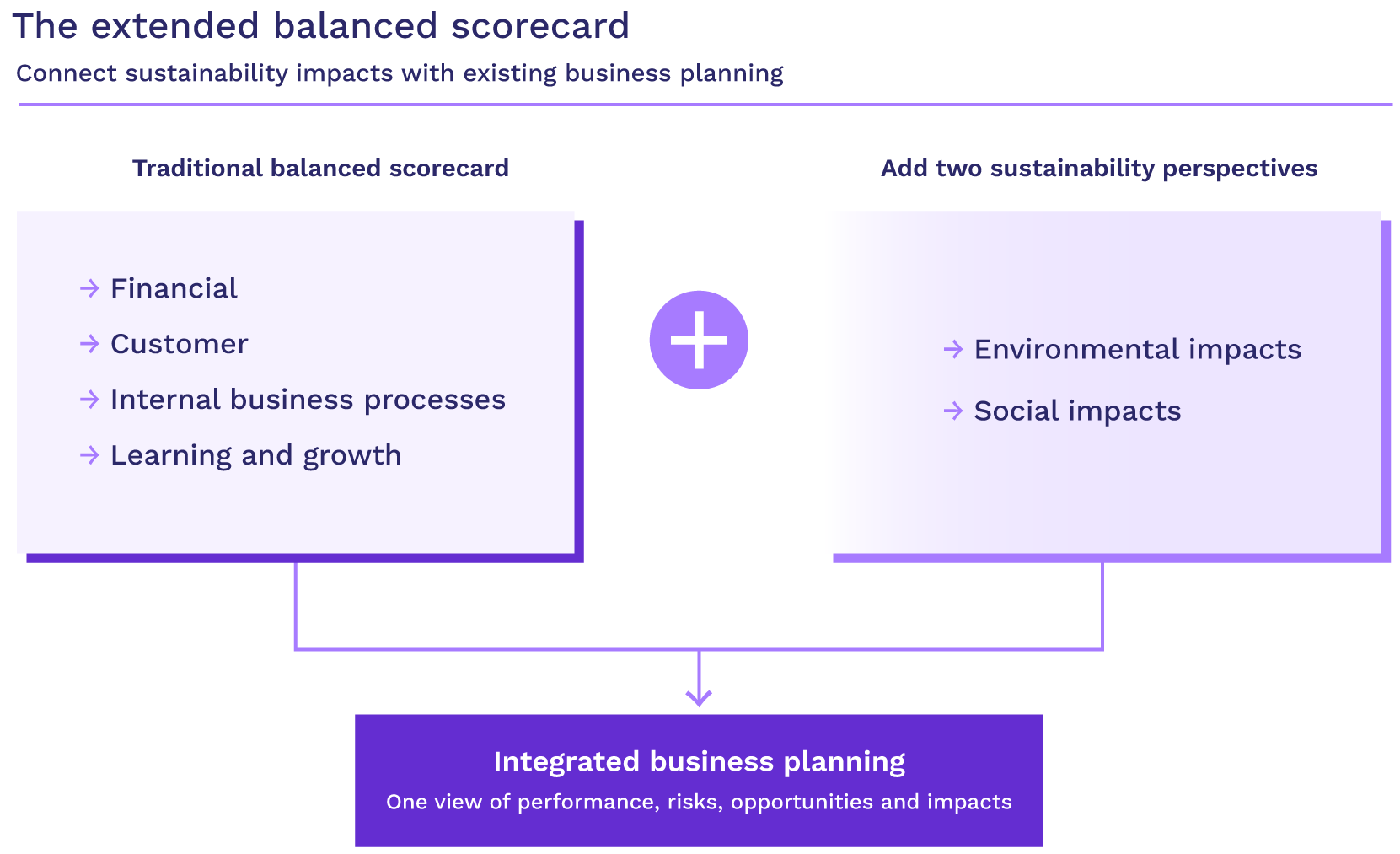
Expanded balanced scorecard connecting financial, customer, business process, learning, environmental and social performance. Source: thinkstep-anz
The extended balanced scorecard turns what could be very disconnected reports into a single management tool. It also makes future disclosures easier because the evidence, ownership and decision-making process are already in place.
Use three lenses to set priorities
An organisation can still end up with a long list of topics, risks, opportunities and data points. When everything appears important, three questions help bring the priorities into focus:
→ How material is this issue, risk or opportunity to the organisation?
→ How material is it to the organisation’s stakeholders?
→ Where can the organisation have the greatest influence?
The intersection of those three lenses often identifies the work that can deliver the most value for both the organisation and its stakeholders. It also helps explain why resources are being directed to some issues before others.
No organisation can predict every reporting requirement that will emerge. It can build a consistent way to identify, assess and manage sustainability-related risks, opportunities and impacts. When the next framework arrives, the organisation can map its existing work to the new requirements instead of starting again. More importantly, it can use that work to make decisions now.