The draft Taskforce on Inequality and Social-related Financial Disclosures (TISFD) Framework is now open for public consultation.
At first glance, it might appear to be another sustainability disclosure framework joining an already crowded landscape. However, for businesses operating in Australia and New Zealand, TISFD may offer something more valuable: a practical roadmap for understanding and managing people-related risks across operations and supply chains.
This is particularly relevant as organisations face increasing scrutiny around modern slavery, human rights, labour conditions and broader social impacts.
Modern slavery reporting is only the beginning
Australia's Modern Slavery Act has now been in place for several years. New Zealand’s Modern Slavery Bill is currently before select committee and, backed by cross-party support, is expected to pass into law later this year. Many New Zealand businesses are already being asked by customers, investors and multinational partners to demonstrate how they identify and manage modern slavery risks.
Modern slavery can easily become a compliance exercise. A statement is prepared, risks are described, actions are summarised, and the report is published. But producing the challenge is often the easy part.
The more difficult task is developing the governance, systems, processes and data needed to genuinely understand people-related risks across complex value chains.
This is where TISFD becomes interesting.
Why TISFD matters
TISFD is not a modern slavery framework. It takes a much broader view of social impacts, covering workers, communities, consumers and inequality throughout the value chain.
However, the skills and systems it encourages organisations to build are closely linked to to modern slavery laws.
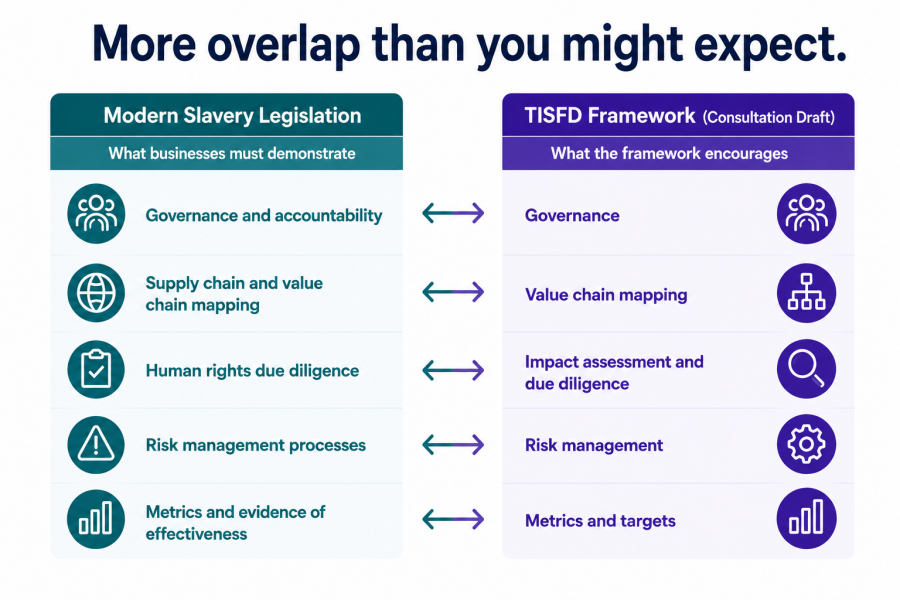
1. Governance
Modern slavery legislation requires organisations to explain how risks are governed and overseen.
The TISFD Governance pillar encourages organisations to establish clear board oversight, management responsibilities and accountability for people-related risks.
For many businesses, this creates the governance structure needed to support modern slavery reporting and broader human rights due diligence.
2. Strategy and value chain mapping
A core requirement of modern slavery legislation is understanding operations and supply chains.
The TISFD Strategy pillar encourages organisations to map value chains, identify stakeholders and understand where social impacts and vulnerabilities may exist.
This exercise often provides much of the information needed to identify potential modern slavery risks and prioritise areas for further investigation.
3. Risk management and due diligence
Modern slavery legislation requires organisations to identify, assess and address risks.
The TISFD Risk Management pillar provides a structured framework for integrating human rights and labour risks into broader enterprise risk management processes.
Rather than treating modern slavery as a standalone issue, organisations can embed it within existing governance and risk systems.
4. Metrics, targets and effectiveness
One of the most challenging aspects of modern slavery reporting is demonstrating whether actions are actually making a difference.
The TISFD Metrics and Targets pillar encourages organisations to develop meaningful indicators and track progress over time.
This can help organisations move beyond reporting activities and begin measuring outcomes and effectiveness.
Beyond compliance
Perhaps the greatest opportunity is avoiding duplication.
Many organisations currently approach modern slavery, human rights, social impact and ESG disclosures as separate reporting streams. This can create fragmented processes, inconsistent data and unnecessary effort.
TISFD offers the possibility of building a more integrated approach. Instead of creating separate systems for each disclosure requirement, organisations can develop a single capability to understand and manage impacts on people across their value chains.
What this means for Australia and New Zealand
For Australian businesses, TISFD may provide a useful framework for strengthening and maturing existing modern slavery programmes.
For New Zealand businesses, it could offer a practical roadmap for building capability ahead of upcoming legislation.
Whether TISFD ultimately becomes widely adopted remains to be seen. However, the consultation draft provides a useful indication of where expectations are heading.
The organisations that invest now in understanding people-related risks, governance and due diligence are likely to be better prepared, not only for modern slavery legislation, but for the broader evolution of social and sustainability reporting.
The consultation draft is open now, providing an opportunity for businesses, practitioners and stakeholders to help shape the future direction of social-related disclosures.
Not sure where your business stands on modern slavery risk? Talk to our team about your next steps.