Our CEO Barbara Nebel reflects on James Shaw’s talk: The future of sustainability
I recently attended a sustainability talk hosted by the Institute of Directors. Guest speaker, Former Minister for Climate Change of New Zealand James Shaw, posed a powerful and pressing question: What comes after what comes next? It is a question that moves beyond short-term business planning and challenges us to look a decade ahead - into a future marked by both uncertainty and inevitability.
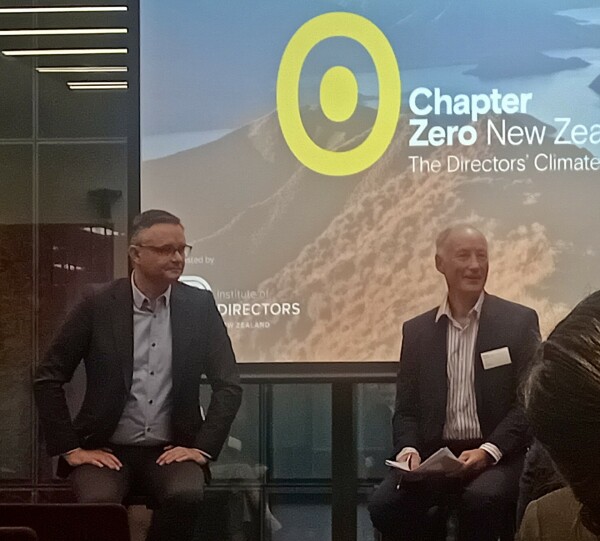
What follows is a summary and reflection based entirely on my notes from his talk.
The known unknowns: political and environmental futures
While Shaw humorously remarked that “in 10 years, Donald Trump will be nothing but a painful memory,” he also acknowledged the deeper unknowns - such as the development set in motion now, the future trajectory of leadership in Government, geopolitical developments in the Pacific, and the broader global political landscape. These uncertainties, however, contrast sharply with the certainties we face.
One of those certainties is the deepening climate crisis. Shaw was unequivocal: within a decade, we will surpass 1.5 degrees of warming. This milestone will not stand alone - it will arrive alongside a biodiversity crisis and a dramatic surge in the role of artificial intelligence.
Artificial Intelligence and Environmental Pressure
Shaw projected that AI will become a core infrastructure component of our economy. Currently accounting for about 1% of global electricity use, AI could surge to 5% in just ten years. This growth will drive increased demand for water (used to cool data centres) and create more pressure for carbon offsets - exacerbating competition for resources such as irrigation water vital to food production.
Innovation Already in Action
Despite these challenges, Shaw identified several existing innovations that offer hope:
→ CO₂-Scrubbing HVAC Systems: In Finland, a company has adapted submarine technology to fit into commercial building ventilation systems, turning them into net CO₂ sinks.
→ River Restoration: A railway line in Oxfordshire, which crossed a flood-prone river 26 times, became a catalyst for environmental restoration to reduce long-term costs and risks.
→ Food Waste Recycling: In Australia, a company transforms food waste into chicken feed by using fly larvae - a modular system that can be deployed in hotels and restaurants to close the loop.
Investment in nature and biodiversity
Shaw also discussed nature-based solutions, particularly biodiversity credits. The UK, for example, has adopted a pragmatic model that requires developers to restore 110% of any developed greenfield site elsewhere. Rather than defining “units of biodiversity,” they use simple, enforceable land area requirements.
He highlighted the potential of land-based aquaculture to replace harmful oceanic fishing practices. If New Zealand repurposed just 1% of its farmland for this method, it could eliminate the need for wild catch, reducing ocean plastic pollution and environmental damage.
Energy and water: the twin pillars of resilience
On the topic of clean energy and water, Shaw underscored the promise of biomethanol as a marine fuel - forecasting its adoption within the next five to ten years. While sustainable aviation fuel remains further off, the momentum is clearly shifting toward lower-emission alternatives.
His closing anecdote was sobering: the last time atmospheric CO₂ levels were this high, palm trees grew in Antarctica. While continent is now in a different place thanks to tectonic shifts, the point remains - our planet is changing, and the scale and speed are unprecedented.
Consumer power and systemic change
Shaw challenged a popular sustainability narrative: that consumers are key drivers of change. He argued that consumers operate within systems, and it is businesses and governments that must provide sustainable choices. “Choice editing”, where companies global food processing suppliers to improve sustainability, is where real change happens. It is not about individual consumer decisions, but institutional policy, regulation and risk mitigation.
The role of AI in reporting
Finally, he touched on sustainability reporting. While companies often lament that no one reads their 40- to 60-page sustainability reports, Shaw believes AI will change this. In the near future, AI will scan these reports, extract key insights, and feed them into financial platforms like Bloomberg, impacting investment decisions and valuations.
Conclusion: The Future is Now
James Shaw’s insights remind us that the future is not just something we plan for - it is something we shape today. From adopting existing innovations to redefining how we measure success, businesses and policymakers must take proactive, systemic steps. What comes next is near-term strategy. But what comes after is where the real transformation must begin.