Increasing innovation in the built environment, collaboration and a closer connection to nature were topics discussed at the recent Green Business Council of Australia’s (GBCA) TRANSFORM conference.
Attended by members of thinkstep-anz’s Green Building team in Sydney, the two-day conference focusing on Australia’s sustainable built environment explored sustainability topics including embodied carbon, green buildings, and circular economy.
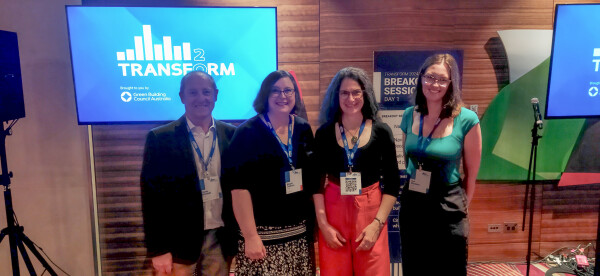
Left to right: Stephen Mitchell, Nicole Sullivan, Barbara Nebel and Tori Wouters

Our main takeaways:
1. Embodied carbon and circularity are now boardroom topics
’Sustainability topics have reached different levels of decision-makers,’ says thinkstep-anz CEO Barbara Nebel. ‘There’s also a lot more collaboration taking place that includes exchanging ideas and different parts of the supply chain working more closely together.’
2. Action, collaboration, innovation. They’re all needed
Here’s a quote from one of our clients. We couldn’t agree more!
‘Action, collaboration and innovation are all required to achieve reductions in embodied carbon of 35% and just under 40% for residential reinforcing mesh products.’ David Bell, Manager Sustainability and Insight, InfraBuild, talking about his company’s products.
3. ESG now plays an important role in financial institutions’ risk frameworks and business decisions
As a major financial institution, ANZ bank spoke of how ESG factors are now ’a huge part’ of their risk framework.
Sydney-based thinkstep-anz Impact Director Nicole Sullivan says this highlights the change of thinking that’s happening more broadly across business. ‘Businesses are stepping up to take responsibility for their environmental and social impacts and making decisions by asking hard questions right through their supply chains. We’re seeing that evolution in thinking.’
4. We can learn from other countries with ambitious carbon targets and policies
Nicole chaired an embodied carbon panel alongside thinkstep-anz clients including NABERS and ASBEC, and a representative from Denmark’s University of Aalborg’s Department of the Built Environment. ‘It was informative hearing from Prof Harpa Birgisdóttir about Denmark’s work embedding embodied carbon targets into regulations. Plus their continuing efforts to lower targets to make sure Denmark keeps reducing its carbon emissions,’ Nicole says
5. Nature is at the heart of sustainability discussions and decisions
An important message for the building industry was to move away from the traditional approach of imposing the built environment on nature towards a greater connection with nature.
‘We must respect and listen to the wisdom and knowledge of First Nations people. We heard First Nations-led design practitioners speak of humanity as part of the wider ecological system,’ Nicole says.
‘It’s crucial to look down the supply chain and outside the boundaries of a project to find where impacts on nature are occurring.’