The first integrated report for our business, written and designed inhouse, tells the story of our growth between in 2020 and 2021. Using the Integrated Reporting Framework <IR> ourselves for the first time has spurred us to share our tips for producing a quality report. You’ll find these below. Now we’re using what we’ve learned to continue to refine our business strategy, improve our reporting and help our clients publish their own reports.
Whether you’re producing your own <IR> or considering calling on our Communications and Creative Team to help you, we hope you’ll find these tips helpful. But first, what is integrated reporting and why did we choose this format?
What is integrated reporting?
When you’re telling your sustainability story, there are several options. You can add sustainability content to your annual report or produce a standalone sustainability report. This standalone report can follow the Global Reporting Initiative (GRI) Framework.
You can also choose the Integrated Reporting Framework, as we did. <IR> is a new way of thinking about sustainability and business value. It makes sustainability core to (‘integrated in’) how your organisation operates. <IR> shows how your organisation creates or erodes value over time through its inter-connected financial, social, environmental and governance resources. These resources are known as the six ‘capitals’:
- Financial capital (e.g. your business’s financial resources)
- Manufactured capital (e.g. your buildings and equipment)
- Social and relational capital (e.g. relationships with your customers)
- Intellectual capital (e.g. your product’s design)
- Natural capital (e.g. the energy and water you use)
- Human capital (e.g. your team’s skills and knowledge).
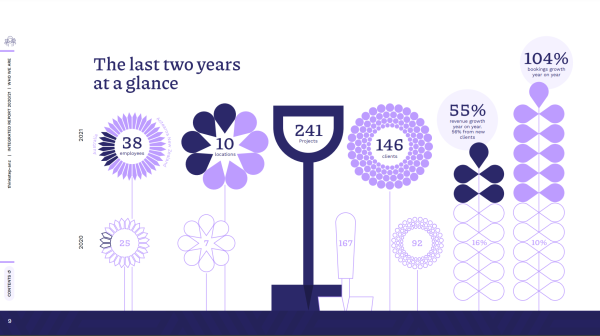
Why we chose <IR> at thinkstep-anz
We like <IR> because the framework shows that sustainable business is about much more than short-term financial results. It’s about creating and managing healthy, cohesive, connected systems over time.
We also like the focus on ‘value’. <IR> helps us understand how our thinkstep-anz people, relationships, financial assets, knowledge, processes and environmental resources come together to create and preserve long-term value for our business. This focus on value shows us what we need to do to make progress and where our future opportunities and challenges lie. It also guides the data we need to collect to measure our progress.
Our tips for getting started
- Confirm your purpose. Why are you writing an <IR>? To comply with reporting requirements? To summarise your sustainability programme for investors or customers who are asking about it? To communicate with local communities and suppliers? To take stock of your sustainability efforts?
- Confirm your audience. This is related to your purpose. Who are you reporting to or communicating with? Your regulators? Your investors? Your customers, suppliers or team?
- Gain your mandate. Check in with the people (usually your organisation’s leaders) who will want to shape your <IR>. Get their ideas and confirm their support early. Then keep them updated.
- Get your ‘building blocks’ in place early. Do a materiality assessment. Update your existing one if it’s over three years old or something big has changed (e.g. you’ve created a new division). Confirm (or reconfirm) the Sustainable Development Goals that are relevant to your business. Advise team members that you’ll be calling on them to provide data for the report. Survey your team to gain those interesting little insights. What does sustainability mean for you outside work? How do you travel? How do you dispose of waste?
- Look for inspiration. Review others’ reports to get ideas for your content and design.
- Get to grips with the <IR> language. Concepts like the ‘capitals’ will be new to most people. Take time to educate them.
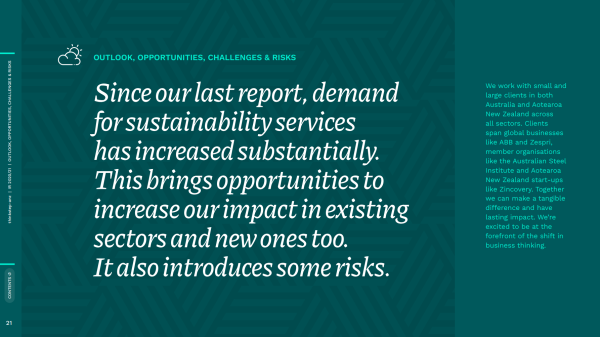
Outlook, opportunities, challenges and risks from Growth, our Integrated Report
Our tips for managing your report
- Treat your <IR> as a project. Develop a project plan with milestones such as sign-offs. Manage your stakeholders. Keep your team updated on progress.
- Assemble your project team. Get the right people in the room from the start: your reporting manager (if you have one), your communications and design team, the people who’ll provide your data.
- Set a timeframe – and stick to it. It’s like packing for a holiday. It takes as long as you let it!
Our tips for choosing your content
- Let your purpose and audience guide you. Write for your reader and the outcomes you want to achieve.
- Show you understand the value of integrated thinking. For example, in our thinkstep-anz <IR> we talk about sharing our skills and knowledge (intellectual capital) through our regular webinars, blogs and conferences. We show how these activities help us attract talented team members (human capital), build our client networks (social and relationships capital) and income (financial capital), and gain ideas for new services (intellectual capital).
- Be transparent. Tell the bad as well as the good by including risks and downsides too. Declaring them will force you to mitigate them. (Then talk about your mitigation strategy.) Show what you’ve learned and educate others.
- Keep your organisation accountable. Include sustainability targets and outcomes. If you’ve fallen short, explain why and how you’re planning to make up ground.
- Make your content engaging. Use case studies to tell your stories. Include content snippets suitable for ‘breakout boxes’ (e.g. ‘Five things we’ve learned’).
- Use plain English writing techniques. Use ‘dinner table language’: concise, punchy language, short words and sentences. Headers will guide your reader through your report; tables will make detailed information easy to read. Make your <IR> a jargon-free zone. (Be gone, ‘synergies’, ‘paradigms’ and ‘alignment’!)
- Use language that works for your stakeholders. Don’t follow the <IR> language slavishly. If ‘our people’ works better for your organisation than ‘human capital’, go ahead and use it.
- Keep your <IR> short. Short reports get read and ‘conciseness’ is one of the <IR> framework’s seven principles. Materiality (reporting what matters), Plain English techniques and infographics are your friends here.
- Banish greenwash! A well written <IR> will boost your brand. Vague, misleading marketing statements that are not backed up by data will quickly erode it.

Our tips for designing your report
1. Invest in design. It will bring your content to life.
2. Use infographics to highlight important content. Infographics are particularly useful to summarise your:
- business model (how you work) to help your audiences understand integrated thinking and reporting
- value chain to highlight the value of strong relationships
- sustainability strategy to show how sustainability adds value to your business.
They’re good for reporting against performance targets too.
3. Source quality photos. Use them to illustrate your organisation – who you are, what you do, how you work. Photos that feature people work well.
August 2022