Martin Fryer, our Head of Strategy and Impact New Zealand, is an expert at assessing business’s climate risks and opportunities. He presented a Masterclass about this topic with the New Zealand Climate Leaders Coalition. We’re sharing this information to help your business understand risks (and opportunities!) posed by climate change.
Read the explainer (in PDF) – or – watch a recording of the masterclass
Why this matters
Assessing and managing your climate risks and opportunities in a structured way will add value to your business.
It will help your business:
- engage with your stakeholders (internal and external)
- become more resilient
- identify commercial opportunities
- refine your strategy
- improve your access to capital
- comply with financial regulations
- build your brand.
It will help you play your part in helping New Zealand mitigate and adapt to climate change and is a requirement for the Climate Leaders Coalition (CLC) Statement of Ambition.
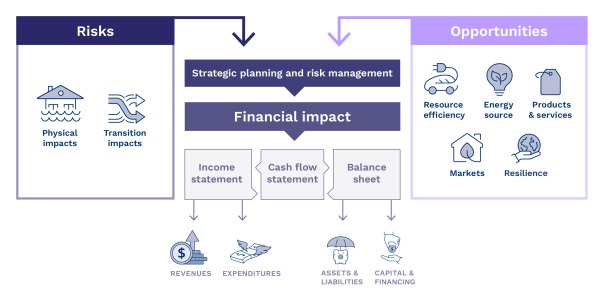
A diagram showing risks and opportunities of climate change when disclosing risk
Getting started
1. Set up your team
Climate risk touches many parts of your business and your working group should reflect this.
To make the best use of your resources and add the greatest value, start by looking at your whole business, at a high level. Where are the material risks and opportunities for your organisation and supply chain?
Then focus on the material parts of your business and supply chain. Within these areas, you should involve these functions:
- Executive and governance
- Sustainability
- Risk
- Finance
- Operations/asset management
- People/Health Safety and Environment
- Communications
- Legal/Corporate Affairs
If your business is a corporate, these will be distinct functions. If your business is a Small to Medium Enterprise (SME), these functions will be shared across a small number of people.
Multi-nationals generally provide their regional operations with a methodology and let them assess their own risks and opportunities using local data.
2. Agree your scope and boundary
Will you include all your operations? All your locations? Your entire supply chain? All at once or staged?
Our tips
- In year one, start broad. Look at your whole operation, at a high level.
- In years two and beyond, increase your focus. Use what you’ve learned in year one to develop your understanding of your climate change ‘hot spots’
3. Confirm your time horizons
The table below shows some options.
|
External Reporting Board (XRB) horizons |
ISO14091 horizons | Your business planning/investment horizons |
|
|
|
4. Choose your climate scenarios
These are our recommendations:
| Businesses located in New Zealand | Businesses with international operations and supply chains |
| NIWA | Taihoro Nukurangi regional scenarios | IPCC scenarios |
| Near term: 2016-2035 Mid term: 2046-2065 Long term: 2081-2100 |
Near term: 2021-2040
|