Erica Mather talks to Martin Fryer as he settles into his role as thinkstep-anz's Head of Strategy & Impact NZ. Martin shares what sustainability means to him, his influential role in creating positive change at a corporate level, and how he will use his knowledge and skills to further enable companies to succeed sustainably at thinkstep-anz.
You’ve worked with a range of sectors in the past, including renewable energy, aviation, and airports. Why have you chosen thinkstep-anz? What are you looking forward to?
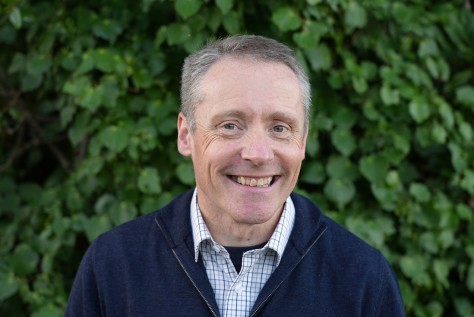
There are lots of things I’m looking forward to. I’ve spent 99 percent of my career working on the inside of large corporate organisations trying to affect change. My previous roles have all been about influencing — both upwards and downwards.
I’ve always toyed with the idea of working in a consultancy role, but I had to find the right organisation. thinkstep-anz is broadening its offerings at a really exciting time when there’s so much momentum around sustainable business. Although it’s a little scary stepping out of the corporate world, whenever I’ve had interactions with other sustainability professionals, they really value the experience I have (I’ve been doing this a long time!). I’m looking forward to sharing my knowledge and experience both with colleagues and clients.
It’s pushing me outside of my comfort zone and providing me with another career challenge. I see it as a fantastic opportunity to grow personally, to grow a team, and hopefully influence a much broader cross-section of organisations across New Zealand. To use the thinkstep-anz phrase, to succeed sustainably.
As a Director of EPD Australasia, can you tell us why EPDs are important?
EPDs provide absolute transparency. That’s what people are looking for now. Yes, they’re interested to see an EPD, but that’s always going to be followed by, ‘What does that mean?’. The level of scrutiny is increasing all the time. The need for rigorous, science-based confirmation is increasing as well. I’ve seen it across all areas of sustainability.
My involvement with EPD Australasia has been fascinating. I think there’s a real opportunity in New Zealand and the primary sector to focus on LCA and understanding the end-to-end impact of a product that is marketed globally. Those global markets are increasingly scrutinising where products are coming from.
When you look at the value those sorts of export industries bring to the New Zealand economy — if exporters use LCA and, produce an EPD, and get ahead of other primary producers, it will give their product such a point of difference. Particularly as the world is coming out of COVID and looking at recovery, as markets reopen, there’s a real opportunity for New Zealand to create a lasting point of difference.
How do you think we can get businesses to accept that wider perspective of sustainability that has traditionally been so dominated by environmental and climate change aspects?
A lot depends on their size. If they’re a large corporate, they’ll be asked these questions from the investment community. Those questions are all elements of Environmental, Social, and Corporate Governance (ESG) practice. Now there’s increasing focus and scrutiny on your social impacts. If New Zealand corporates are operating in Australia, they have to produce modern slavery statements and look at their supply chain through that lens. It comes back to the need for transparency.
I think now at an SME level, they’re all part of a value chain. Someone along the value chain is going to start asking questions about their social performance. For some, it will be business-critical because it will mean success or failure in terms of remaining on somebody’s supplier list. The drivers are not going away. The interconnectedness of business is helpful in this sense, but they need to understand consumers are incredibly well-connected as well.
Organisations have to consider an increasing array of elements to manage reputational risk. It’s no longer just environmental compliance, but a much broader question: What are you doing as a good corporate citizen?
You’re keen to help set meaningful targets, ensuring sustainable business practice adds value. Tell us about working on the first science-based target in New Zealand and your mission.
The fact it was the first was a coincidence! For a number of years, the airport company had a significant focus on improving the efficiency of assets and infrastructure at the airport. What we wanted to ensure was that future development of terminal infrastructure was as sustainable as it possibly could be. So, we produced our own design standards based on the efficiency we were able to create right across the terminal, setting a benchmark for future terminal expansion.
We took the opportunity to raise the bar. Those design standards drove the conversation around: We’ve come to the end of this energy efficiency focus; we’ve minimised our carbon footprint as much as we can — where do we go next? It was really, really difficult to benchmark the efficiency of terminal infrastructure with other airports.
So, I turned to the science-based targets initiative. I thought, if we are going to set a new emissions reduction target, it needs to be based on science and needs to provide a focus for future design of terminal infrastructure. The rest is history — I looked at the sector-based approach the Science Based Targets initiative (SBTi) were taking and followed their guidance as to what an ambitious target would look like. For an airport company, the major emissions are associated with Scope 2 — it’s all about energy consumption in your terminal, but as they expand the focus turns to construction projects and materials. That was an opportunity for the airport company to set a science-based target and engage with their supply chain.
What is your experience with TCFD?
The TCFD framework is all about managing future risk to financial stability. Obviously, climate change is a massive risk.
My experience at Mercury involved looking through the TCFD lens right from the top, asking questions like: What is the governance of climate change risk — where is responsibility at board level? How is Mercury creating its strategy around effectively managing climate risks? How does that filter down into management roles and responsibilities within the organisation — what are we doing about our physical impacts on the environment in terms of climate change? It really is a top-down approach and very broad.
Mercury has been working on TCFD disclosures for the past 3-4 years, gradually improving the maturity of disclosures around climate change risk. That’s the ultimate aim of the TCFD framework — to get corporates to disclose their true understanding of the risks of a changing climate so that it gives the investment communities confidence that organisations have this under control and are a safe investment.
It’s also now regulated here in New Zealand. There are 200 large corporations and organisations that will have to publicly disclose following the TCFD framework by 2023. That’s not far away!
How does communication play a part in getting others to embrace changes in sustainable business practice?
Science communication is crucial to break down barriers with large corporates (and any kind of business) and communicate some pretty complex concepts and ideas to get understanding, buy-in, and traction.
I worked at Auckland Airport for 10 years (my first broad sustainability role). Prior to that I worked in environmental management. The drivers for sustainability in large corporates in particular are based on assessment and management of risk. In 2005, Auckland Airport produced a strategic risk review which looked out 10 years. They identified the potential impact of carbon charges on long-haul tourism and trade.
It was risk-driven, but that was the starting point for a much broader conversation. It provided the hook for them to start thinking about sustainability in its broadest sense.
The language itself — the conversation — may not be initially about sustainability, but about risk or the viewpoint of an important stakeholder. That triggers people to think about what else they should be looking at. Their eyes open to the bigger picture.
Climate change has been the trigger for a huge number of organisations who realise, ‘We need to look at our carbon footprint; we need some science around that; how are we going to measure that?’
From a communication perspective, it’s broadening the initial conversation to include other elements of sustainable business in a way that doesn’t overwhelm people. For me personally, it took me a long time to get my head around sustainability and what it actually meant to me as an individual, let alone the organisation I was working for.
You have to come to terms with sustainability on a personal level to then be able to communicate it and drive it with other people and within organisations.
From your experience as a university lecturer at AUT, what do you think the future of sustainability and business will be like?
I was invited to produce a paper on climate change and carbon strategies for the AUT’s MBA programme, which was absolutely fascinating. In an MBA, students come from very different disciplines, but all have chosen a sustainability specialisation at Master’s level. The ones that signed up for the climate change strategies paper realised how important that topic was becoming and would become in the future.
Interacting with the next generation of sustainability professionals gives me a huge amount of hope. We know we’ve got less than 10 years to sort out climate change. But there’s a lot of passionate people coming through which makes me feel even better about what I can contribute.
What does sustainability mean to you?
It comes down to understanding the impact you’re having in its broadest context — the impact on the planet, on people, and the opportunity that you have to reduce the negative impacts and improve the positive. It forces you to look at your own values and what you really value.
I was brought up in a rural environment and saw the negative impacts of agriculture moving away from small family farms to agribusinesses with the loss of biodiversity. That was as a child, and it definitely influenced me.
As you get older and have children of your own, your perspective changes. Certain values become even stronger.
Organisations live by values as well and need to understand the values held by their many stakeholders. So, sustainability is about tapping into those values in relation to the impact on the planet and the planet’s people. People are part of the planet! We really shouldn’t differentiate the two.
What are the most sustainable and the most unsustainable things you’ve done in the last 12 months?
I’ve installed 14 solar panels on the roof which are merrily generating. I’ve become a distributed generator. One of the more unsustainable things I’ve done is replace my second car with another internal combustion engine (ICE). I had a certain budget, and even a second-hand fit for purpose electric vehicle (EV) didn’t fit into that budget. It really sits uncomfortably with me because I know that vehicle will be with us for a number of years. But hopefully by then, there’ll be far more EVs in the second-hand market. For a sustainability professional to buy another ICE was really hard!
So you obviously enjoy New Zealand and the beautiful environment here must suit you. When you’re not thinking about sustainability, what do you get up to?
Fishing is something handed down from my father and now I’m handing it down to my kids. We don’t do as much of it as I’d like. My son and I recently tried to catch a salmon on the Rakaia River. We got the jet boat up the river with a guide and camped out on the side of the river — where else in the world can you do that?
In the past couple of years, we’ve become a family of runners. My son wanted to try running so we started doing park runs on a Saturday morning. Then we found a local running group and a coach. There’s no better way to unwind from a stressful day. When I work from home, I enjoy being able to just put my running shoes on and disappear for a break to de-stress.