In 2025, sustainability matured. The conversation moved beyond noise and box-ticking, with more organisations focusing on resilience, long-term value and credibility.
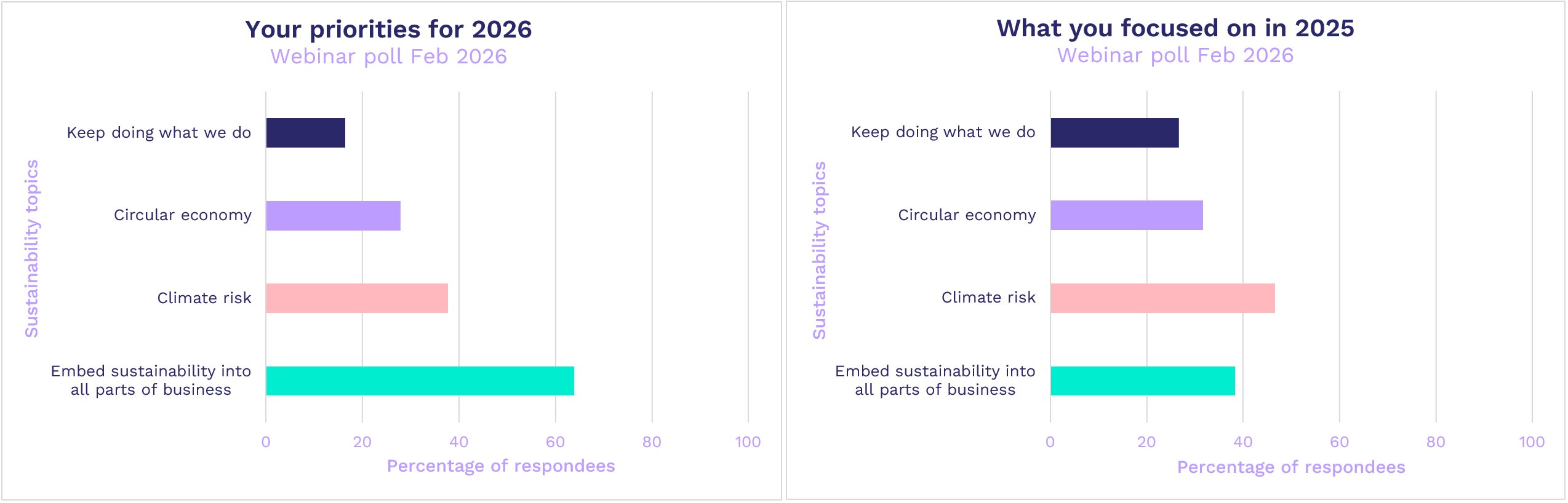
At the start of our webinar, we asked participants two simple questions:
→ What did you focus on in 2025?
→ What will you prioritise in 2026?
The responses showed a clear shift in thinking.
In 2025, many organisations were still focused on maintaining the status quo and managing increasingly complex reporting requirements. Looking ahead to 2026, priorities are shifting towards embedding sustainability into core business strategy, strengthening decision-making processes and linking action directly to value creation.
In this replay, thinkstep-anz CEO Barbara Nebel, Impact Director Nicole Sullivan and Technical Director Jeff Vickers reflect on what 2025 has taught us and outline what leading organisations are likely to do differently in 2026 to build resilience and maintain trust.
You will learn:
→ Why sustainability strategy is increasingly owned by boards and CEOs, not just sustainability teams
→ Why ambition without evidence is eroding trust with investors, regulators and customers
→ How establishing clear baselines and taking measurable action builds credibility over time
→ Why trying to measure everything creates noise and distraction, and how to focus on what drives impact
→ How consistent, incremental improvements strengthen long-term resilience
One message came through clearly in the discussion: sustainability is no longer only about managing risk and meeting compliance requirements. It is becoming a core part of business direction, capital allocation and long-term value.
Watch the replay here:
Barbara: From risk management to business direction
What we learned in 2025
→ Sustainability is no longer sitting on the sidelines: Boards and CEOs are taking ownership.
→ Even with lighter reporting requirements, organisations keep going – risk and stakeholder expectations remain.
→ Focus is shifting from risk management to the business value sustainability brings.
What this means for 2026
→ Leaders will embed sustainability in core strategy, not just compliance
→ Stakeholder engagement will target what really matters. “If you consult with your stakeholders… that gives you so much more credibility.”
→ Small, steady improvements are meaningful progress toward long-term goals.
Nicole: Credibility, action and real business value
What we learned in 2025
→ Ambition alone isn’t enough; businesses must prove progress.
→ Reliable data is essential. “We need things like clear baselines so that we can know where we're starting from.”
→ Sustainability creates opportunity – risk and opportunity assessments help companies launch new processes/products and save money.
What this means for 2026
→ Leading organisations link sustainability to business value for long-term impact.
→ Communication will be clear and specific – not just “We are sustainable.”
→ Organisations take responsibility for suppliers’ emissions and support improvement.
→ Credibility comes from data, transparency and follow-through.
Jeff: Data, measurement and staying focused
What we learned in 2025
→ Measuring everything for the sake of it creates noise. Measure what matters.
→ Sustainability initiatives succeed when data is consistently measured and then tied to decisions.
→ Circular economy will move beyond recycling, backed by credible, traceable data and verified metrics such as MCI.
What this means for 2026
→ Focus measurement on what truly matters to stakeholders and the business.
→ With AI and tools producing more data, clarity and focus are critical.
→ Incremental action now, even if voluntary, builds resilience for future regulation.