Reducing embodied carbon is one of the most effective ways to lower emissions in the building and construction sector. It accounts for a significant share of the construction sector’s emissions and presents one of the most immediate opportunities to make a real impact.
That’s why, for the past three years, thinkstep-anz has been working with a wide range of organisations to better understand and reduce embodied carbon.
Explore the reports
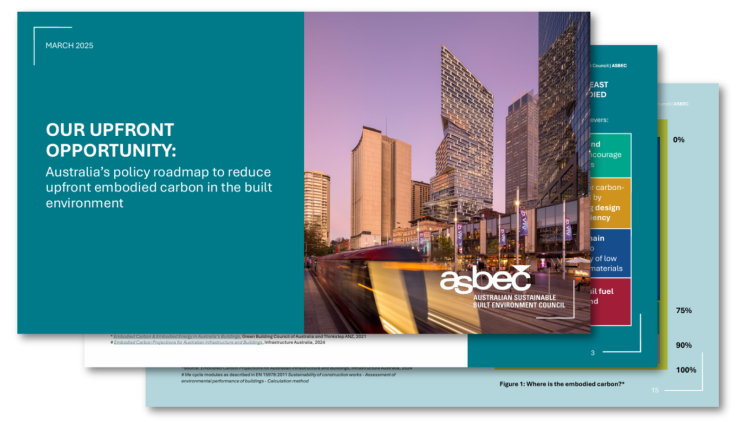
Our upfront opportunity: Australia’s policy roadmap to reduce upfront embodied carbon in the built environment
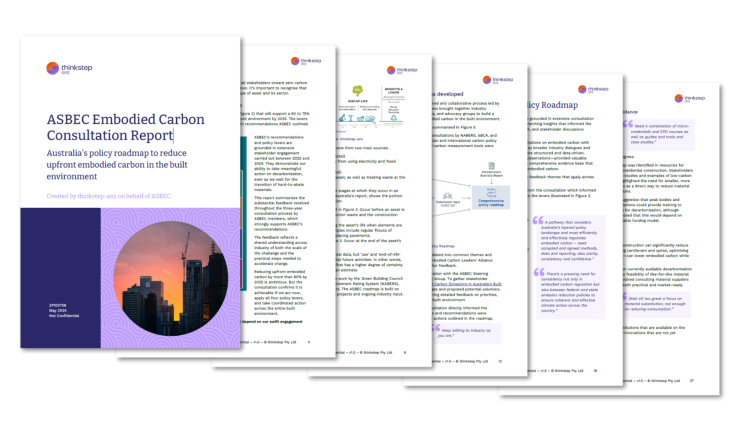
thinkstep-anz's consultation report: Insights that shaped ASBEC's Policy Roadmap
We collaborated with the Green Building Council of Australia (GBCA), the National Australian Built Environment Rating System (NABERS), Infrastructure Australia, and the Department of Climate Change, Energy, the Environment and Water (DCCEEW) to understand industry and government needs, challenges and opportunities. In 2024–25, we supported the Australian Sustainable Built Environment Council (ASBEC) and Mansfield Advisory to bring all of this work together into a national conversation.
→ Together, we’ve developed a strong foundation of research and engagement that underpins ASBEC’s Policy Roadmap:
Our upfront opportunity: Australia’s policy roadmap to reduce upfront embodied carbon in the built environment
This roadmap presents a national framework to support, enable and speed up the transition to net zero embodied carbon across the built environment. It recognises that tackling upfront embodied carbon is one of the fastest ways to lower emissions from construction. It also helps drive innovation and boosts the production and use of low-carbon materials in Australian industries.
A collaborative journey, built on evidence
The roadmap is the result of a rigorous, collaborative process from 2022 to 2024. It draws on:
- existing research and policy, both local and international
- industry and government feedback from NABERS, GBCA, Infrastructure Australia, DCCEEW and many stakeholders
- direct consultation through ASBEC’s 2024 Issues Paper: Embodied Carbon Emissions in Australia’s Built Environment.
Stakeholder engagement was central to the process. More than 60 organisations provided feedback to ASBEC and thinkstep-anz through surveys, webinars and written submissions, helping to prioritise the biggest challenges and most effective solutions.
Our contribution: Sharing the consultation insights
To support the roadmap and ensure transparency, we’ve published a companion piece:
thinkstep-anz's consultation report: Insights that shaped ASBEC's Policy Roadmap
Our report outlines how we have distilled input that backs ASBEC’s final recommendations. It highlights the key themes from consultation, such as the importance of procurement standards, clarity in measurement and demand signals for low-carbon materials and demonstrates the strong support for a coordinated national approach.
Why this work matters
Australia’s built environment can reduce embodied carbon in two powerful ways:
- How we design and deliver projects: using fewer, smarter resources
- What we specify and buy: creating demand for low-carbon solutions and supporting local innovation
Reducing upfront embodied carbon is one of the fastest ways to cut emissions in the built environment and to do that, we need reliable tools and clear targets.
Since 2022, we have been the technical partner to NABERS in developing a new tool to measure upfront embodied carbon. Built in collaboration with the GBCA and shaped through industry consultation since 2021, the tool aligns with international standards and complements work already underway in Australia’s infrastructure sector
Explore the reports
- Our upfront opportunity: Australia’s policy roadmap to reduce upfront embodied carbon in the built environment
- thinkstep-anz's consultation report: Insights that shaped ASBEC's Policy Roadmap
Together, they offer a clear direction and a solid foundation for action. If your organisation plays a role in shaping the built environment, this is your invitation to help accelerate the shift to net zero embodied carbon.