10 September 2026
The designs may be timeless, but the environmental data behind them needs to stay current.
More than a decade after registering the first environmental product declaration (EPD) under the then newly launched Australasian programme, New Zealand design company David Trubridge has published its second update.
“Being first has never worried us much,” the David Trubridge team says. “We’ve always been more concerned with being honest than being conventional.”
Released in July 2026, the latest EPD covers 52 products and size variants across 15 lighting families, including well-known designs such as Coral, Koura, Nikau and Navicula.
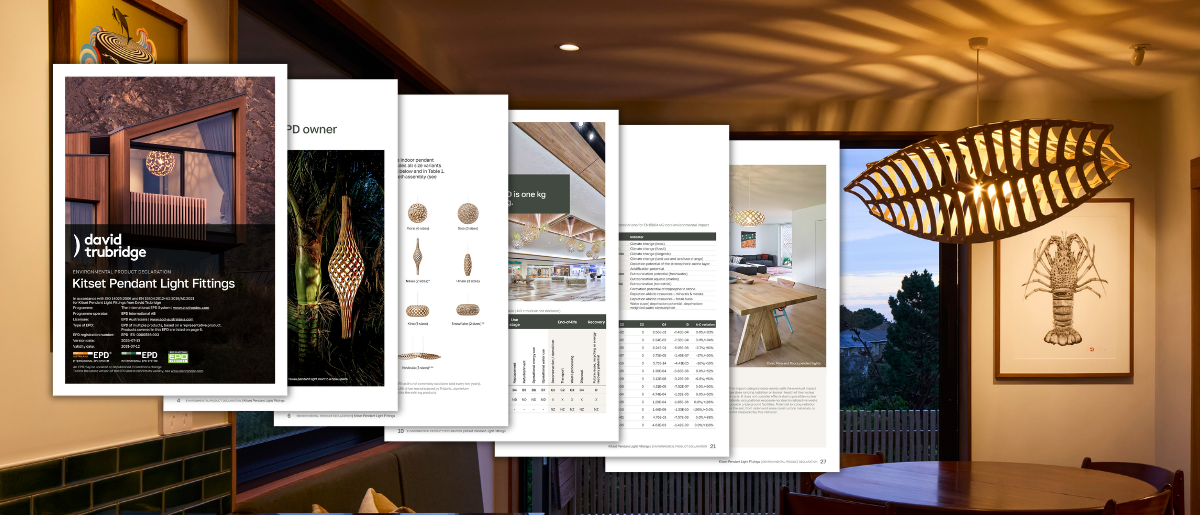
An EPD uses life cycle assessment (LCA) to provide independently verified information about a product’s environmental impacts. EPDs must be updated at least every five years, or sooner if significant changes could affect the results. This keeps the data relevant and gives architects, designers and customers credible information for their decisions.
For David Trubridge, the original EPD was a way to test and verify the company’s environmental claims – even if the results were not as positive as it hoped.
“It’s not a marketing exercise; it’s an accountability exercise.”
A decade later, that independent evidence remains the EPD’s greatest value.
“The main benefit has been being able to back up what we say with something independently checked, rather than asking people to just take our word for it.”
The EPD has also supported practical opportunities. In 2019, Google and Gensler Architects requested environmental information about the company’s Snowflake light for a Living Building Challenge project in the United States.
The latest update continues a long-standing relationship between David Trubridge and thinkstep-anz. We supported the original declaration in 2015 and completed the LCA for the latest version. That continuity has helped us understand how the business and its products have developed over time.
EPDs are now better understood and increasingly expected in some markets, although they remain unusual for a company of David Trubridge’s size. More than a decade after leading the way, the company does not want verified transparency to remain a point of difference.
“We’d rather the whole industry catch up to verified transparency than stay ahead of others who aren’t doing it.”