The circular economy conference Circularity 2023 brought together government, industry, service providers and many more to discuss how to turn knowledge into action and implement change across the Asia Pacific.
The second Circular Economy conference hosted by the Australian Circular Economy Hub and supported by Planet Ark took place in Melbourne this year on 20 – 21 November. thinkstep-anz’s Senior Circular Economy and Strategy Specialist Sally-Anne Kasner presented at the conference and was a judge at the associated 2023 Australian Circular Economy (ACE) Awards.
Sally shares with us some of the highlights from the conference:
- The Ministerial Advisory Committee (Australia) will publish the National Circular Economy Framework for Australia in 2024. Circular economy will be included in the National Reconstruction Fund and six sector plans for energy, industry, buildings, transport, resources and agriculture.
- Circular design acknowledges that global supply chains and trade are complex. Transitioning to circularity needs a collaborative effort across borders, i.e. a just and equitable transition across supply chains that addresses more than carbon.
- Inconsistent regulations between Federal, State and local governments often hinder efforts to implement circular options.
- The good news is that many States are busy implementing circular options despite regulatory challenges, through procurement and waste management programmes. In Victoria, for example, 14 councils are collaborating and participating in a reusable nappy project!
- Heinz Schandl (CSIRO) shared some sobering insights about critical materials:
-> Australia’s recycling rate is 52% (this is how much end-of-life waste people recycle)
-> The circularity rate is 5.1% (material that is returned to a second use)
-> The circularity potential is a mere 20% based on current material characteristics and technologies. The European Union’s circularity potential is 40%.
- The conference considered biomimicry (nature-inspired design) and learning from how to reconnect with our land. This was supported by an Indigenous Knowledge session that revised a version of Kate Raworth’s popular doughnut and presented it as a Country-centred Circular Economy Strategy (‘Country’ is a term indigenous Australians often use to describe the land, waterways and seas they are connected to.)
Circularity 2023 emphasised that the shift to a more circular future is complex. The term ’collaboration’ was mentioned in almost every session with the idea of circles of collaboration. Systems thinking and the circular economy are seen as an ecosystem that involves many people.
In summary, it was a great event, with many inspiring leaders to help navigate the transition. Illustrator Elise Motalli created this graphic to summarise the two-day conference.
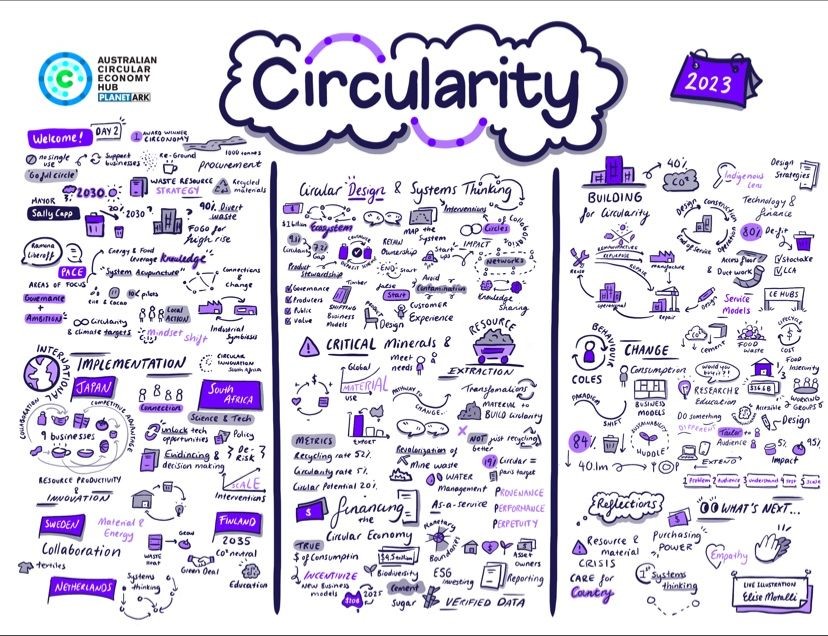
Illustrator Elise Motalli's summary of Circularity 2023
If you are interested in what more circular options could look like for your business, please get in touch with our Head of Circular Economy Jim Goddin.