The challenge
Toyota New Zealand engaged us to produce its first climate-related disclosures. These were voluntary disclosures for the 2023 financial year (FY23).
With climate disclosures mandatory in Aotearoa New Zealand in FY24, the company wanted to know it had all the information it needed to disclose accurately and fully. The business also knew reporting would help it better understand how climate change affects its business and how it should manage the risks and opportunities involved.
About Toyota New Zealand
 Toyota New Zealand (TNZ) is a wholly-owned subsidiary of Toyota Motor Corporation. The company imports and sells new Toyota and Lexus vehicles, used vehicles and parts. It is based in Palmerston North, New Zealand, and has 65 Toyota stores and eight Lexus dealerships across the country.
Operating more sustainably is important to the business. TNZ has an approved science-based target for reducing its greenhouse gas emissions and plans to be net-zero carbon by 2050.
What we did
Reviewing the technical data against the regulations
Our technical reporting team explained the External Reporting Board (XRB)’s Aotearoa New Zealand Climate Standards. We showed the company the information TNZ needed to disclose to align with the Standards and the recommendations of the former Taskforce for Climate-related Financial Disclosures (TCFD).
TNZ collated the relevant data for FY23 and we reviewed it against the Standard’s four ‘reporting buckets’: governance, strategy, risk management, and metrics and targets. This review confirmed the information TNZ needed for its public report and identified gaps to fill for FY24.
Producing the public disclosures
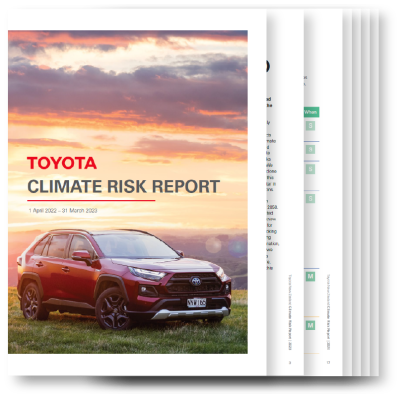
Our Communications and Creative team created a simple, attractive report for TNZ’s climate disclosures. The report featured the company’s branding, was written in plain English and included engaging infographics and other design features that highlighted important information.
How we are supporting Toyota NZ to succeed sustainably

Our work with TNZ is supporting the company to:
Comply with mandatory requirements
In FY24 TNZ can produce a report that accords with the XRB’s New Zealand Climate Standards.
Manage climate-related risks
We supported the TNZ management to identify and manage the business’ climate-related risks. These include extreme weather events.
The disclosures challenged TNZ to answer two sets of questions. The first is about process. What governance and management processes are we using to identify, measure and manage our risks? Who’s involved? What tools are we using? Are they fit for purpose? For example, these questions identified that the company needs to continue to build in-house knowledge about climate change in the coming years.
The second set of questions concerns the risks themselves. What risks do we face and when? What types are they and how big? How are we managing them? For example, these questions identified that extreme weather events can seriously disrupt operations and supply chains.
Manage climate-related opportunities
The same process supported TNZ to identify opportunities to improve TNZ’s business. For example, technology offers opportunities to create lower emission vehicles.
Improve its strategy
Strategy is one of the four parts of the TCFD framework. Producing this report has shown TNZ where it needs to focus to mitigate, and adapt to, the impacts of climate change. The company can build this knowledge into its business strategy.
Strengthen relationships with external stakeholders
A concise, thorough report shows TNZ’s customers, potential customers, suppliers and other business partners that the company is serious about mitigating and adapting to climate change. The report also makes it easy for TNZ to respond to requests for information about its climate-related activities.
Engage internal stakeholders
Producing the FY23 disclosures brought together people from across TNZ’s business, including sales, customer service, corporate affairs and finance. The report shows team members that TNZ is eager to communicate openly, with them and with others. It also highlights that many TNZ team members will need to play their part to manage the physical and transitional impacts of a changing climate in the coming years.