Developing ASBEC’s embodied carbon policy roadmap for Australia’s built environment.
The challenge
Reducing embodied carbon is one of the strongest opportunities to cut emissions in the building and construction sector. But progress stalls when efforts are scattered.
ASBEC, the peak body for organisations committed to improving Australia’s built environment, saw policies and programs popping up in isolation. Each tackled only part of the problem, creating gaps and confusion.
ASBEC needed a partner who could bring everyone together, connect government, industry and researchers, and turn complex, inconsistent evidence into practical, evidence-based policy direction.
Our role went beyond research. We connected technical insights with policy design, facilitated cross-sector collaboration, and ensured the results were clear, actionable, and ready to drive impact.
Together with ASBEC and partners, we’ve created a foundation for Australia’s next step toward a low-carbon built environment - one grounded in data, collaboration and shared purpose.
"thinkstep-anz brought structure and clarity to an incredibly complex challenge. Their deep understanding of embodied carbon, combined with rigorous analysis and meaningful stakeholder engagement, helped us uncover the key barriers to decarbonising Australia’s built environment. They turned a tangle of research and perspectives into clear, actionable steps for change," Alison Scotland, ASBEC CEO
What we did
We brought our expertise in embodied carbon, policy, and communication to the table - and our ability to get the right people working together.
We partnered with Mansfield Advisory and policy expert Dr Dominique Hes. Together, we worked with ASBEC’s members, NABERS, the Australian Department of Climate Change, Energy, the Environment and Water (DCCEEW) and the GBCA. Our goal was to bring government and industry together to agree on the key challenges and solutions.
We started by reviewing more than 250 policies and regulations from over 20 countries, including 104 regulatory instruments. We analysed 30 leading policy examples and 34 additional research sources to understand the strategies that drive real change. We built on our previous work for NABERS and Infrastructure Australia, ensuring strong continuity and avoiding duplication.
We then designed and led a stakeholder engagement program that brought together representatives from government, industry, and the supply chain. The aim was to identify shared challenges, align expectations, and test the practicality of proposed policy approaches.
Our findings and the outcomes of these discussions formed ASBEC’s Issues Paper on Embodied Carbon Emissions in Australia’s Built Environment. The paper identified seven ‘decarbonisation dilemmas’ - critical challenges to resolve before broader policy implementation - and outlined 45 potential solutions. It invited industry and government to help shape a national framework for embodied carbon.
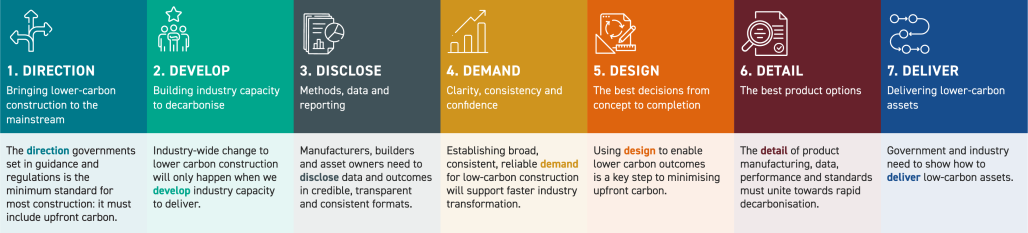
The outcome
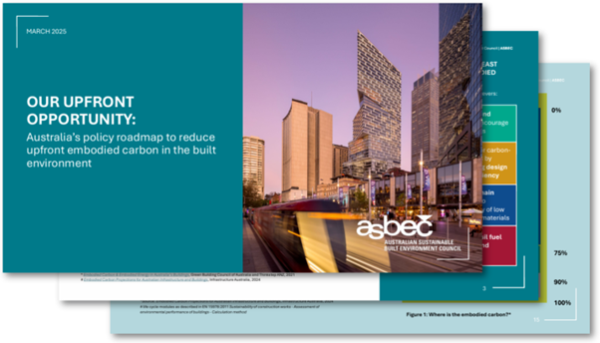
The Issues Paper became the foundation for a national conversation on embodied carbon policy. It created shared understanding across sectors, clarified priorities, and set the direction for ASBEC’s Our upfront opportunity: Australia’s policy roadmap to reduce upfront embodied carbon in the built environment
The project demonstrated that complex policy challenges can be solved through collaboration, deep research, and effective communication. By combining technical rigour with clear language and inclusive engagement, we helped ASBEC build momentum for change and align the industry around a common goal - reducing embodied carbon across Australia’s built environment.
"thinkstep-anz helped us connect ideas, evidence and people to drive policy alignment across the sector. They worked closely with stakeholders across industry and government, listened carefully, and built trust to find common ground. Their collaborative approach ensured the policy roadmap was not only evidence-based but also had genuine buy-in across the sector," Alison Scotland, ASBEC CEO