
The challenge
Hospitality New Zealand represents more than 2,500 businesses, from cafés and restaurants to hotels and bars. Members are at different stages of their sustainability journey, so the organisation needed a clear, practical strategy that worked for everyone.
The industry was also under pressure. After the pandemic and amid rising costs, many businesses were stretched thin. Hospitality New Zealand wanted a strategy that focused on what mattered most and could be put into practice without adding extra burden.
“It was really important for us to work with a trusted partner to go out to the industry to see what really mattered to them,” says Hospitality New Zealand Sustainability Manager, Megan Williams.
What we did: Finding what matters most
We started with a materiality assessment to identify the environmental, social and economic topics most relevant to hospitality businesses and their stakeholders. Our team engaged with members, suppliers and partners through interviews and a survey to rank issues. "We wanted to find the right balance between what we thought we should be doing, what our members wanted us to do, and what the suppliers thought was the right thing to do," Megan adds.
The consultation confirmed that some of Hospitality New Zealand’s existing work already reflected member priorities, giving confidence that the final strategy would be useful and relevant across the sector.
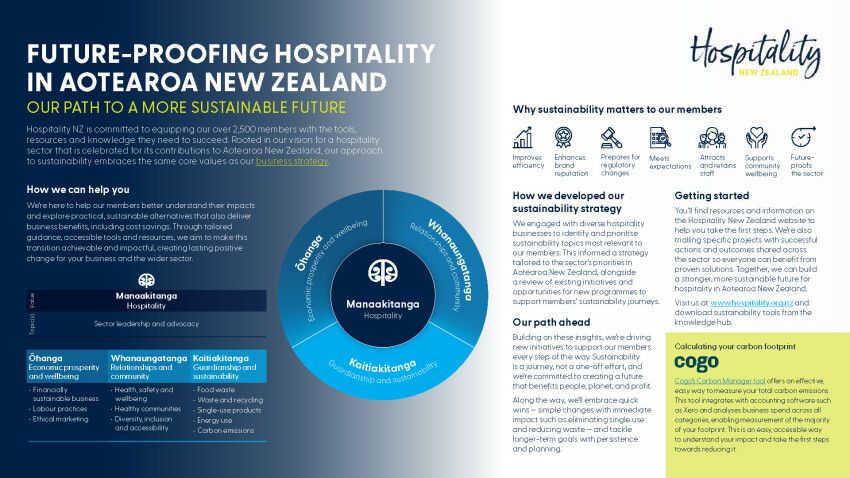
Together we identified 12 priority topics grouped under the organisation’s core strategy: manaakitanga (hospitality), ohanga (economic prosperity), whanaungatanga (community relationships) and kaitiakitanga (guardianship and sustainability).
Communicating clearly: Turning data into action
Once priorities were clear, our in-house Communications and Creative team turned the findings into clear, practical tools. Because they understand both sustainability and design, they could quickly translate complex ideas into plain English and create infographics that linked Hospitality NZ’s strategy to its sustainability goals.
“The team at thinkstep-anz were able to convert a great deal of data easily and creatively into succinct visuals and tables for quick reference by our stakeholders,” Megan said. The results were a concise summary and a detailed strategy document - both easy to read and useful for everyone from small café owners to large hospitality groups.
The outcome: Practical tools and a clear direction
Hospitality New Zealand launched its first sustainability strategy in early 2025. The strategy fits within its five-year plan and helps members cut waste, manage energy, measure emissions and improve efficiency. It also aligns with eight United Nations Sustainable Development Goals.
Alongside the strategy, the organisation introduced a Low Carbon programme (LoCarb) with WellingtonNZ, using the Cogo carbon management tool to helps businesses measure and reduce emissions. Within weeks, over 20 businesses had joined, with interest growing nationwide.
Regional managers were trained to support members, and the strategy was shared through newsletters, events and direct engagement.
The impact: Building confidence and capability
We equipped Hospitality New Zealand with a practical, engaging strategy for a diverse and time-poor sector. The robust materiality process ensured strong foundations, while clear communication made the strategy easy to understand and act on.
“We’ve worked with businesses that have significantly reduced their costs and their carbon footprint through doing some of these things, at the same time as enhancing their brand," Megan said.
The collaborative process also strengthened relationships with members. By listening early and reflecting their priorities, Hospitality New Zealand built trust and encouraged participation in sustainability initiatives - turning sustainability into practical action across the industry.