The challenge
 Hunter Joint Organisation (Hunter JO) set out to accelerate the shift to circular procurement across its member councils – turning strong policy intent into consistent action in day-to-day decision-making. Councils already influence how materials are used, maintained and recovered through procurement. The opportunity is to use this influence to reduce waste, improve asset performance and deliver better long-term value for communities.
To support this transition, it needed a clear, shared approach that could be applied across multiple councils, was easy to use and reflected the realities of regional supply chains.
What we did
We partnered with Hunter JO to develop a Circular Procurement Toolkit tailored to council procurement, asset management and project teams.
The toolkit is designed to fit within existing processes and support better decisions without adding complexity.
The work is grounded in research. We examined key national and state frameworks, standards and verification systems related to circular procurement, including ISO 20400, ISO 59020, the NSW sustainable procurement guidance, the Transport for NSW Materials Register, industry tools and much more. This ensured the toolkit was credible and aligned with policy.
The toolkit is structured as a series of guides that introduce the rationale for circular procurement and breaks down opportunities into clear, actionable steps that councils can apply immediately.
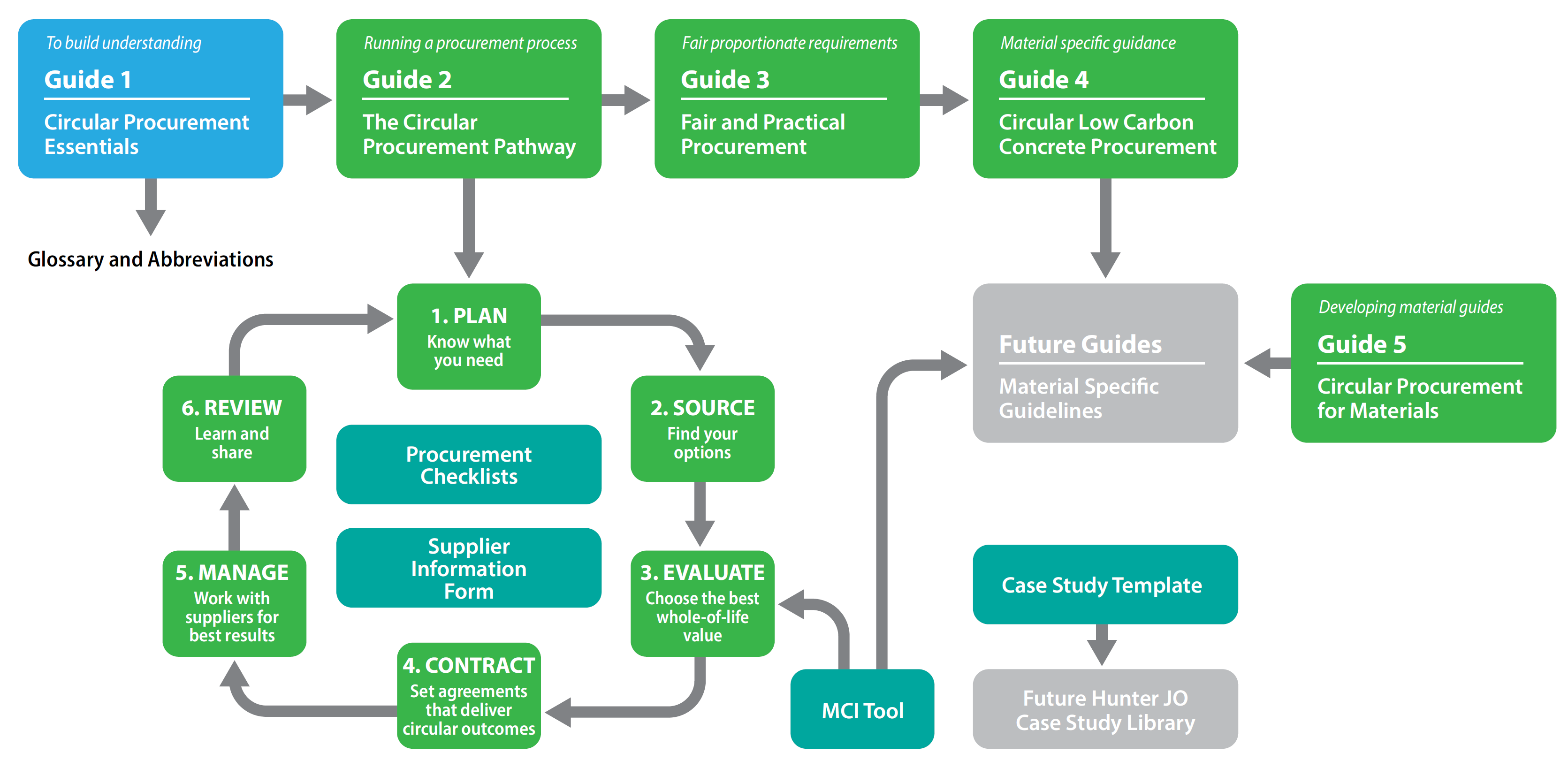
Hunter JO's circular procurement toolkit at a glance
It includes plain English guidance, a step-by-step procurement pathway, clear and practical actions in a council context and tools such as checklists, supplier forms and model brief and contract clauses. A strong focus is placed on proportionate, risk-based evidence requirements that work for both large suppliers and regional SMEs.
A key focus area was low-carbon concrete, given its importance in council infrastructure. We developed targeted guidance to help councils confidently specify and assess lower-carbon concrete. This was supported by a custom Material Circularity Indicator (MCI) tool. The MCI provides a single score that shows how circular a product is – capturing material inputs, use and end-of-life outcomes – so councils can compare options and make more informed decisions.
We also developed a framework for future material-specific modules and case study templates, enabling councils to expand the toolkit over time, capture lessons learned and share practical examples across the region.
The impact
The toolkit gives councils a clear and practical way to embed circular thinking into everyday procurement and deliver better outcomes over time.
- Consistent regional approach: Clear, practical method for embedding circular procurement across councils
- Actionable content: Specific examples of more circular actions and how to use briefs and contracts to support more circular outcomes
- Reduced waste outcomes: Less waste through reuse, repair and better specification
- Better value decisions: Stronger focus on whole-of-life value for the community, not just upfront cost
- Improved material choices: Greater confidence in procuring low-carbon concrete and key materials
- Stronger local supply: More accessible procurement for regional suppliers and SMEs
- Ongoing capability building: Shared foundation for learning, collaboration and continuous improvement
About Hunter Joint Organisation
'The Hunter Joint Organisation is a collaborative body that brings together the ten councils in the region to provide a united and local voice for their communities. As the hub for local intergovernmental collaboration, their statutory mandate includes identifying key regional strategic priorities, advocating for these priorities and building collaborations around these priorities with other levels of government, industry and community.'
This project is an initiative of the NSW Environment Protection Authority under the NSW Government’s Waste and Sustainable Materials Strategy, and is funded from the waste levy.