Australia’s first National Climate-Risk Assessment (NCRA) delivers a clear message to business: prepare now or pay later.
The report identifies the nation’s most pressing climate risks and lays the foundation for national adaptation planning. It shows how climate change will reshape the environment, society, and economy in the decades ahead and makes clear that no Australian community or business will be immune. These risks won’t arrive one at a time; they will be cascading, compounding, and concurrent.

Not a distant challenge
The report also makes clear: climate change is already here. More frequent flooding, longer bushfire seasons and coastal erosion are damaging homes, businesses and infrastructure. Ocean warming risks collapsing fisheries and tourism, while worsening droughts threaten food production. Left unchecked, these changes will strain supply chains, essential services and social cohesion.
Australia's 11 priority risks:
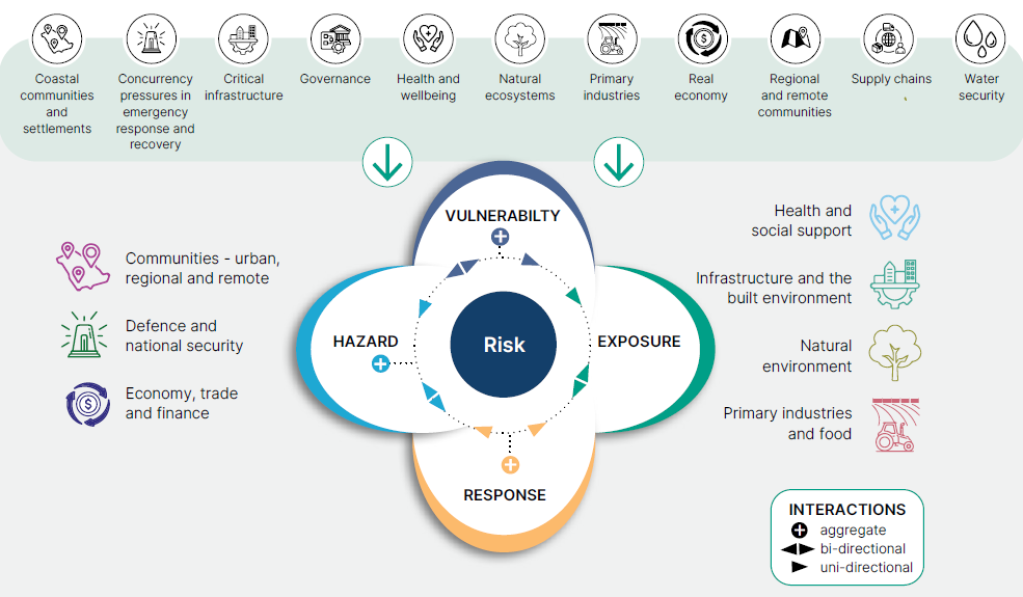
Source: Australia’s National Risk Assessment 2025
The economic costs of climate change
The financial impacts are stark and growing:
Rising disaster losses: Insured losses have more than doubled, from $2.1 billion in the late 1990s to $4.5 billion today. Insurance affordability is worsening, with 15% of households already paying premiums worth more than four weeks’ gross income.
Future costs: By 2050, disasters could cost $40.3 billion annually. Government recovery spending could multiply five- to seven-fold this century.
Property and productivity at risk: Property losses may reach $611 billion by 2050 and $770 billion by 2090. Heat stress could cut national output by $135–423 billion by 2063, especially in agriculture, construction and mining.
These costs will show up not only in disasters and insurance but in reduced growth, higher household stress and greater pressure on government budgets.
Why businesses can’t ignore these risks
Risks are unfolding now: Climate change is already disrupting supply chains, raising insurance costs and reducing workforce productivity. These are not future scenarios; they are today’s realities that will intensify.
Plan for what will happen: businesses need strategies that account for foreseeable impacts:
- Droughts will reduce crop yields, drive up food prices, disrupt exports and pressure agribusiness finance.
- Floods will damage transport corridors, delay deliveries, raise costs and undermine customer confidence.
- Heat stress will cut productivity across agriculture, mining and manufacturing.
Embed adaptation in strategy: integrate climate risk into governance, investment and everyday decision-making. Ask:
- How exposed are our assets, people and suppliers?
- What needs to change now to remain competitive in the future?
- Where are the opportunities - from resilient infrastructure and renewable energy to new technologies and services?
How businesses can benefit from the NCRA
The NCRA is a timely reminder that climate-related disclosures are not just a compliance exercise. They are a chance to take stock of risks and show stakeholders the steps you are taking now to prepare for the future.
The timing is particularly useful for organisations developing disclosures aligned with AASB S2. The report's summaries, organised by region and sector, are a helpful guide for understanding and acting on physical risks and opportunities.
The NCRA also provides insights into how risks may grow over time. This helps businesses make more robust assessments of the impacts of a changing climate on their operations, supply chains and financial outlook.
What the NCRA doesn’t include
The NCRA looks only at physical risks, things like floods, droughts, storms and heatwaves, and how Australia can prepare for them. It does not look at the other side of the climate challenge: the transition to a low-carbon economy. That transition includes changes such as shifting to renewable energy, phasing out fossil fuels, introducing new regulations, and adapting business models to cut emissions.
Both sides matter for climate-related disclosures:
Physical risks are about how climate change will affect your operations, assets and supply chains.
Transition risks are about how government policy, market shifts and new technologies will affect your business as the economy decarbonises.
Hopefully the transition occurs at a pace that limits warming, avoids the extremes highlighted in the NCRA and reduces the need and cost of adaptation.
Act now to stay resilient and competitive
The risks may be daunting, but the NCRA also points to opportunities. Adaptation will create demand for climate-resilient building materials, smarter water management and community resilience services. At the same time, the transition to a low-carbon economy is reshaping markets, policies and technologies. Businesses that prepare for both - building resilience to physical risks and positioning for a decarbonised economy - will not just reduce risk but safeguard their future, protect their place in the market and stay ahead in a world that is rapidly reshaping.

How risks were assessed
The NCRA draws on the latest climate science, national data, expert workshops and community engagement. Using the Intergovernmental Panel on Climate Change (IPCC) framework, it considered hazards, exposure, vulnerability and response capacity. From this, it identified 11 priority risks with the greatest potential consequences and the most urgent need for action.
Understanding the language: what are climate risks?
Climate risk is the chance of harm from a climate event, and it depends on four things:
- the hazard itself: for example, a storm, drought or flood
- exposure: people, places or assets in harm’s way
- vulnerability: how sensitive those people or assets are and how able they are to cope
- response: the actions we take to manage risks, which may not always work as intended or could create new issues.
Australia’s 11 priority climate risks at a glance
- Communities – urban, regional and remote
Urban growth areas are exposed to floods and heat, remote communities face fragile supply chains, and regional towns may see population shifts as people leave high-risk areas. - Defence and national security
Defence forces will face growing demands at home and abroad as disasters increase, while instability in nearby regions could create new security challenges. - Economy, trade and finance
Extreme weather threatens productivity, disrupts markets, and increases costs. Insurance is already under pressure, and by 2050 disaster costs could reach $40 billion a year. - Health and social support
Heatwaves, smoke, floods, and emerging diseases will increase illness and mortality. Health systems and social services will come under growing strain, and mental health impacts will rise. - Infrastructure and the built environment
Roads, rail, energy grids, and telecommunications are vulnerable to extreme events. Repair costs will escalate, and failures in one system can cascade through others. - Natural environment
Ecosystems like coral reefs, forests, and wetlands face irreversible damage, threatening biodiversity and industries such as tourism and agriculture. - Primary industries and food
Farming, fisheries, and forestry are highly climate-sensitive. Droughts, heatwaves, and shifting rainfall will reduce yields, disrupt supply, and increase price volatility. - Water security (cross-system risk)
Aridity, drought, and floods threaten reliable access to safe water for households, industry, and ecosystems. - Supply chains (cross-system risk)
Extreme weather will disrupt food, fuel, and medicine distribution. Freight corridors and ports are particularly exposed, creating ripple effects across the economy. - Coastal communities (cross-system risk)
Rising seas, stronger storm surges, and erosion threaten millions of Australians. Insurance retreat is already an issue, with major economic and social costs looming. - Governance (cross-system risk)
Strong, coordinated governance will be critical. Poor decisions or delays risk magnifying losses and leaving communities and businesses exposed.
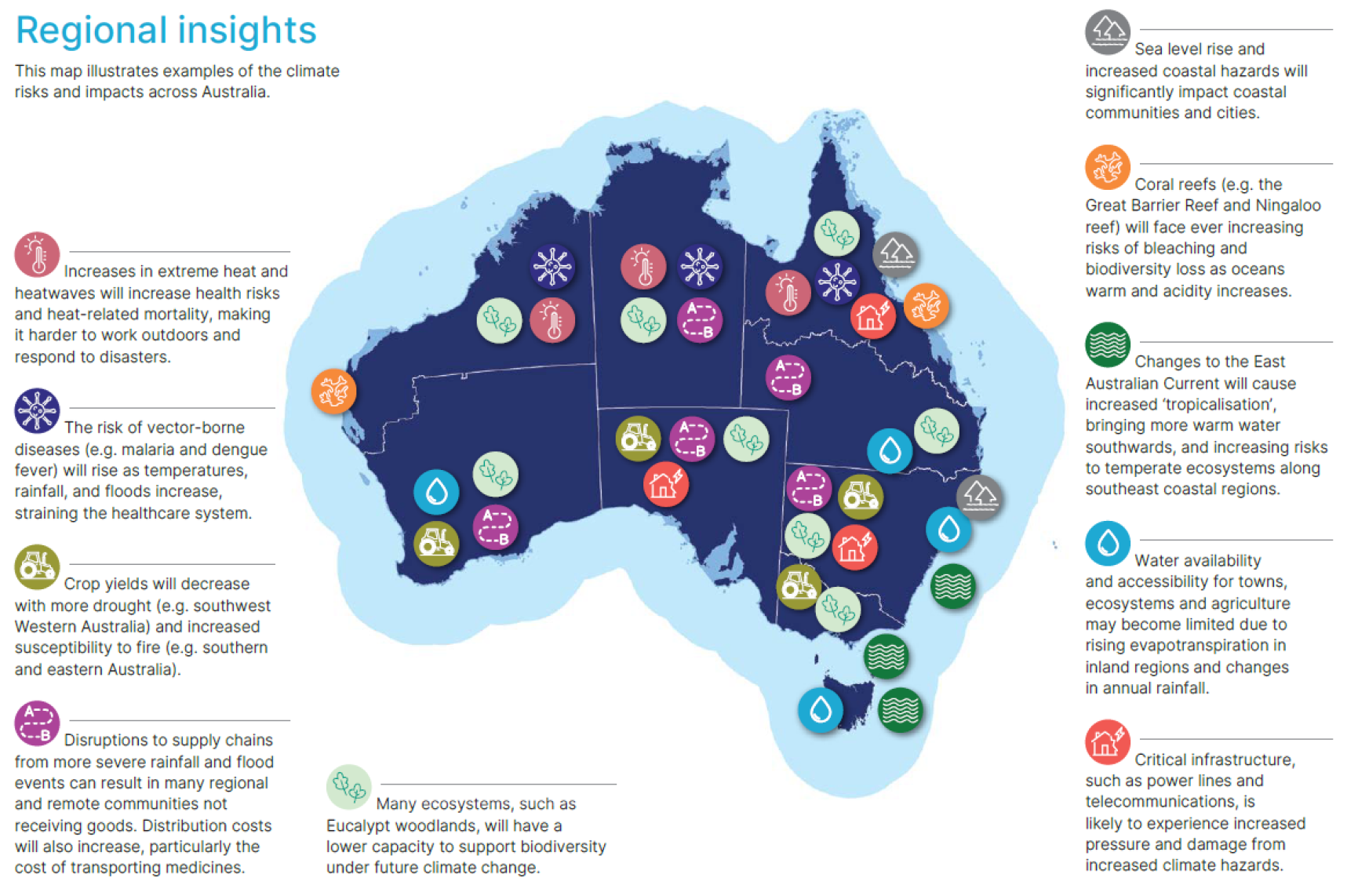
Source: Australia’s National Climate Risk Assessment 2025
Do you need help with understanding the risks and opportunities a changing climate brings to your organisation? Get in touch with our experts who can guide you through.