Our resident Regenerative Futurist Phil Tate sits down for a chat about the philosophies behind regenerative thinking, how it can differ from sustainability, and what the future might hold for Australia and New Zealand in this thinkerview.
What led you to become a regenerative futurist?
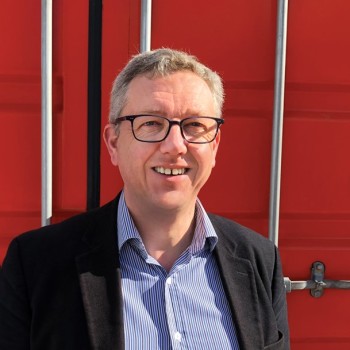 The thing that started it for me was reading the October 2008 special edition of the New Scientist entitled 'The Folly of Growth'. At the time, the global financial crisis was upending many of our deeply held assumptions about how the commercial world worked. Several articles in that edition addressed the profound conviction I felt that collectively we were not on the right track. I was working in a senior technology strategy role, and the articles by Herman Daly, David Suzuki, and Tim Jackson directly led me to transition into corporate sustainability so that I could influence the organisation's outlook.
I was introduced to the discipline of strategic foresight at a 2011 workshop. After further training at the University of Houston, I became an independent consultant to assist organisations in examining their core assumptions and anticipated futures.
It's a continual process of self-development, too, though. I wanted to re-challenge my thinking, which led me to complete the Regenerative Practitioner course a few years back that was hosted by the Regenesis Group. The two disciplines, foresight and regenerative practice, are complementary. Any future we aspire to needs to be regenerative if our descendants are to have a liveable planet.
The word 'regeneration' seems to be everywhere these days. Why do you think that is?
While regenerative thinking has applicability across all our activities, it seems most prominent in the farming sector, as it is critical for addressing the climate challenge. Support for the practice is reflected in Australia's 2018 Farm Profitability and Biodiversity report and in New Zealand to redress soil degradation and bring a more balanced approach to farm practice. Globally, Unilever has introduced their 2021 regenerative agriculture principles, and it's three years since think tank Wunderman Thompson Intelligence’s report 'The New Sustainability: Regeneration'. Given the prominence of ‘regeneration’ in such global publications, it certainly seems like the ‘R word’ has caught fire in the last couple of years.
Human development is at a crossroads, and the path we collectively take in the next half-century is critical. Twelve years ago, while engaged in the Al Gore programme, I experienced climate scepticism and outright denial. That isn’t so much the case today. We're just starting to understand the magnitude of change required. According to recent estimates, the probability of staying below 2°C of warming is only 5 percent, given our current policies.
So is regeneration the next level of sustainability, or do you see it as fundamentally different?
We tend to think of progress in linear terms. After recognising that historical business practice has caused harm, we’re embracing the need to reduce damage with more sustainable practices that aim to do good.
Regeneration seeks to create life using a living systems perspective that recognises the need to evolve the capacity of all beings to express their unique essence. That is not a simple explanation, but it aims to draw our attention towards thinking in these terms, rather than more straightforward phrasing that loses the opportunity for more profound insight. It demands that we address our natural bias to cling to familiar approaches and extrapolate these into an assumed future. Foresight approaches also assist us to reflect on our current perspectives to develop a greater level of future consciousness.
What are the motivations for an organisation to take up regenerative thinking?
Adopting a regenerative approach has significant benefits for future-focused organisations. Developing a regenerative perspective helps to evolve a more resilient outlook and generate innovation by creating tension between organisations’ desired future state and their current business practice. As the Wunderman Thompson report noted, customers and employees want to prepare for the future. So, organisations need to decide how they can contribute to addressing the anticipated changes over the coming decades.
In the broader context, it’s clear that incremental approaches aren’t proving to be adequate, and neither is organisational strategy.
What particular opportunities and challenges do you see for New Zealand and Australia's future?
As two countries with significant levels of wealth, both Australia and New Zealand have the potential to embrace a regenerative future that enables society and business to thrive within the boundaries of the planet. Examples such as Regen Melbourne demonstrate how this is already being explored at the city level. Given our position, we need to show leadership here and, as Regenesis’ Bill Reed suggests, “act as an acupuncture point for the world”.
The challenge for us is in lifting our perspective and embracing new futures. The pandemic is driving this change globally, but its comparatively low impact in Australasia could see us adopt a more complacent approach. It would be a real missed opportunity.
What simple steps can individuals and organisations take to start thinking longer term?
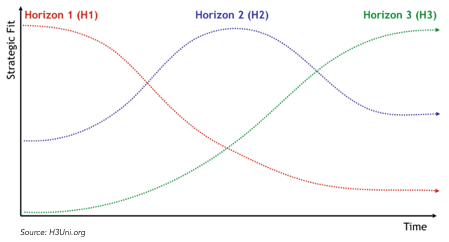
Three Horizons is one of several strategic foresight tools that encourage creative thinking about the future in this blog by Phil Tate.
Surfacing and checking your assumptions is always a good place to start. By reflecting on the world view that supports them, you can begin developing new perspectives that will not control the future but start to evolve the capacity to adapt as it unfolds. To help clients unlock this thinking, I often use the H3Uni.org tools, many of which are available online.
A critical step here is to make time to reflect, read, and (un)learn. I’m currently reading Roman Krznaric’s ‘The Good Ancestor; How to think long term in a short-term world’, which is an excellent primer for developing a regenerative vision. I continually recommend Daniel Wahl’s ‘Redesigning Regenerative Futures’ for regenerative practice that I’ve found a valuable resource over the years.
When you're not thinking regenerative futures, what do you get up to?
I’ve been playing the viola in orchestras for the past forty years, and most recently that’s been with the Wellington Chamber Orchestra. Given that we generally play music between 100 and 250 years old, I’m keen to see that we leave a similarly positive legacy for our ancestors. Perhaps thinking regenerative futures never entirely goes away.