‘Why do I have to account for emissions from my suppliers?’ ‘Doesn’t measuring Scope 3 emissions mean they’re double counted?’ Our clients often ask us questions like these.
When our CEO Barbara Nebel was recently working with her neighbour to trim the hedge between their properties, she realised that a hedge is a useful way to explain Scope 3 emissions of greenhouse gases.

Scope 3 emissions (and hedges) are shared
The common link between Scope 3 emissions and hedges is that they are shared. And this means they need a shared approach. They need to be worked on with someone else either inside or outside your organisation (or both) in the case of Scope 3 emissions, or with someone else in the neighbourhood in the case of your overgrown hedge.
A quick recap on Scope 3 emissions
Scope 3 emissions are any emission type that’s not covered by Scope 1 (direct emissions) and Scope 2 (related to your electricity use). This means they are ‘all the other’ emissions in a company’s value chain (all the activities involved in creating, producing, delivering, using and disposing of a product or service). Examples include emissions from purchased goods and services, disposing of waste, employees’ commuting and business travel.
There are 15 categories of Scope 3 emissions, and they can quickly add up to be a large portion of total business emissions – often the biggest.
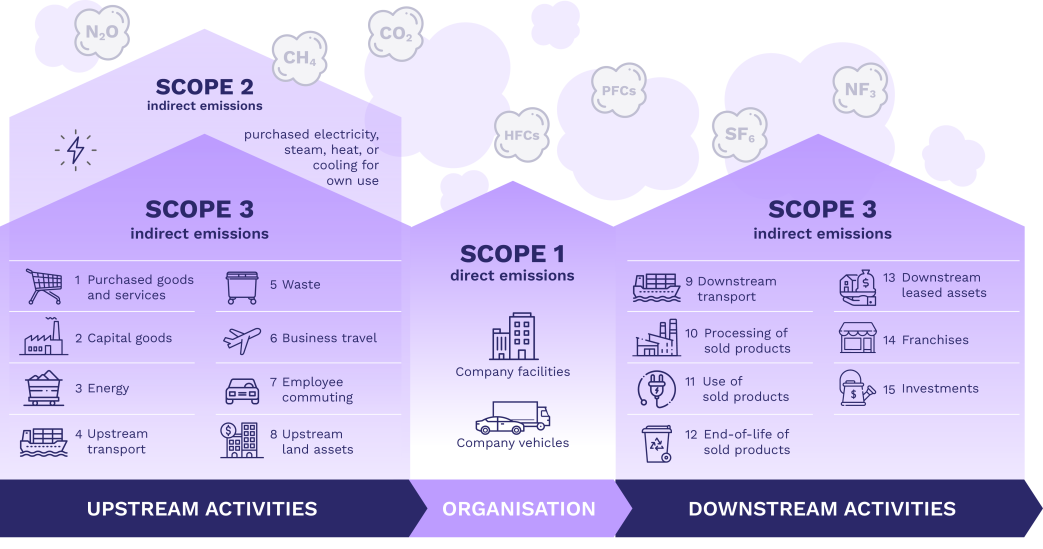
The good news is there are many opportunities to take positive, shared action.

Now back to our hedge
The hedge is a great natural fence. It provides an ecosystem for the insect and bird life that call it home and sequesters (stores) carbon.
However, hedges don’t stop growing, and both sets of neighbours feel the impact of a hedge when it grows too big. On our side it blocks some morning sun. The effects are worse for our neighbours. Their afternoon sun is really reduced, particularly during winter when the sun’s angle is lower.
The hedge impacts us both, so we need to tackle this challenge together. The first thing we do is arrange to meet. We have the tools to trim the hedge, and thankfully our neighbours have teenagers who are keen to help. We both contribute food and drink for sharing afterwards to celebrate a job well done.
As we talk, we may come up with a better solution for the hedge that suits us both. We could remove it altogether or replace it with something needing less maintenance. Together we must work out the benefits, costs and risks of any decision made.
Working together does the Scope 3 job too
Collaborating is at the heart of finding solutions to complex problems. Working with others is essential to take meaningful steps forward with Scope 3 emissions.
For example, for many businesses a big portion of Scope 3 emissions comes from purchased goods and services (Category 1). So set a Scope 3 supplier engagement target. This requires your business to work with suppliers to adopt science-based targets and reduce their (and your) emissions.
Employee commuting (Category 7) and business travel (Category 6) are other areas for a business to act on with others. Work with your employees to encourage carpooling and investigate subsidising lower-carbon travel options like e-bikes. Set a travel policy that requires employees to use technology for most meetings to reduce flying.
Whether you are working with your suppliers, employees, business partners or customers, Scope 3 emissions are about making decisions and taking action together. So, if you need a starting place to tackle Scope 3 emissions, picture a hedge that’s in need of a trim, and say to yourself ‘it’s time to go and say hello to our neighbours.’