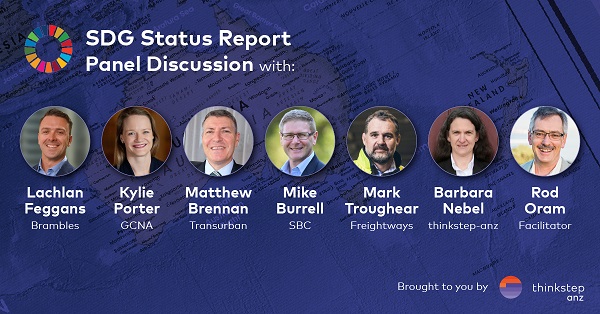
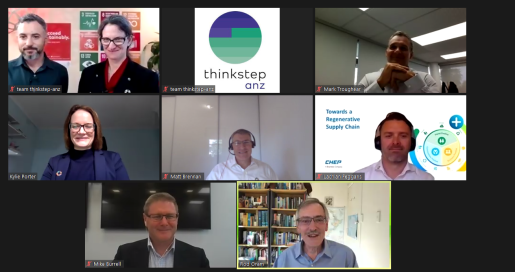
The SDGs present businesses with an opportunity for a mutually beneficial relationship: SDGs provide businesses with a useful framework for guiding strategy and in turn, businesses help to shift the needle on progress for achieving the SDGs. This two-way relationship was highlighted by sustainability and industry experts in our SDG Panel Discussion. This event also celebrated the launch of our SDG Status Report.
Our SDG Report provides a snapshot of how New Zealand and Australia’s top 50 listed companies are reporting on the SDGs. After 18 months of research and writing, it was great to share our findings with such an experienced group of speakers who brought their unique perspectives to the table. Here I reflect on some of the lessons I’ve learnt from piecing this report together, and how the SDGs ready businesses and the whole field of sustainability for success.
SDGs present untapped economic value
The SDGs can have immense value for encouraging innovation, development, and economic growth. The World Business Council for Sustainable Development (WBCSD) estimated that the goals drive at least US$12 trillion worth of market opportunities for businesses across a range of sectors.
Kylie Porter, Executive Director of the Global Compact Network Australia (GCNA) explained how people in senior management roles can seize the opportunity to scale and invest in the broader SDGs. “These are the type of opportunities that boards and executive management like to hear because it directly ties with their budget,” she said.
SDGs are becoming a core part of business
SDGs are noticeably moving away from being an ‘add-on’ and heading towards becoming a core part of business, especially for larger organisations. One of our Australian panellists Matthew Brennan, Head of Sustainability Strategy at Transurban, likened the evolving role of SDGs to that of health and safety regulations — an essential part of businesses today.
Companies that set targets and measure their progress can gain the most from SDGs
 The SDG Status Report found that SDG reporting was stronger in Australia, although both countries leave room for improvement in the quality of reporting.
Organisations with company-specific targets and KPIs are the ones doing the most to push for progress on the SDGs. These organisations go further than selecting SDGs and their related targets. They make the SDGs their own by selecting Goals most relevant to their business operations and translating them into quantitative targets that they can report against. Although they represent a small number of companies in Australia and New Zealand, these companies demonstrate the direction others need to follow to create tangible change with the SDGs.
We need to stop playing ‘SDG Bingo’ and start playing ‘SDG Strategy’
We're now using the SDGs as the basis for our strategy, our sustainability strategy, and our sustainability policy. And we're already starting to see some terrific results with some of the specific indicators and targets that we've picked up. (Lachlan Feggans, Brambles)
‘SDG bingo’ refers to the approach of companies that are trying to tick off as many of the 17 goals as possible, or retrofitting SDGs to their existing activities. Barbara Nebel, CEO of thinkstep-anz, noted that while this trend still needs to be addressed by companies across New Zealand and Australia, “the SDGs increasingly are meaningfully used”.

For Brambles, it was clear that going deep with the SDGs had positive impacts on their business. “Bringing those SDGs through the strategy actually allowed us to amplify our sustainability message much, much more effectively than we would have otherwise done,” noted Lachlan Feggans, Director Sustainability, Corporate & Asia-Pacific. Matthew Brennan recalled a similarly positive experience with taking SDGs to the next level: “We're now using the SDGs as the basis for our strategy, our sustainability strategy, and our sustainability policy. And we're already starting to see some terrific results with some of the specific indicators and targets that we've picked up.”
SDGs are not only for the big companies
While SDGs can be easier to tackle for big organisations, smaller entities shouldn’t be discouraged. There are many small to medium enterprises (SMEs) that can greatly benefit from ditching ‘SDG bingo’ for a more selective approach. SMEs often struggle to produce high-quality reports on a wide range of content like bigger companies do, and therefore their application of the SDGs can be limited. This can be due to limited capacity, time, and resources. Kylie Porter noted, “The SDGs offer them [SMEs] a framework to understand which goals and which sustainable development areas they are able to pull a positive lever on.” In other words, the SDGs should be a source of inspiration, not a cause for inaction.
Link SDGs to the issues that are most important for your company
For us all to progress we need to set goals and measure our progress, which is why I’ve long been a fan of the UN SDGs. They identify 17 utterly crucial measures for progress and set goals for them. (Rod Oram)
Organisations can link their SDG selection to the issues most essential or material for them. Materiality assessments can be a useful place to start for companies — whether big or small — that want to better identify and prioritise material issues. This was highlighted in the industry examples by panellists, Mark Troughear, CEO of Freightways, and Lachlan Feggans from Brambles.
Materiality assessments ensure that companies are engaging with a wide range of internal and external stakeholders. This engagement process identifies issues that can have a material impact on a company, such as revenue, reputation, and compliance. Mark Troughear talked about how the materiality process enabled Freightways to find the issues that most resonated with their business and their investors. “We went to our customers, suppliers, and through a range of the really critical stakeholders in our business to help figure out the materiality and which of these we could really move the dial on…,” he explained.
Mapping material issues against the SDGs provides a global context for sustainability strategy that can be easily reported. Thus, the materiality process connects stakeholder engagement with strategy and draws a path to the SDGs that matter most for an organisation.
Climate action is high on the agenda for Australia and New Zealand
 The SDG Status Report found that Climate action (SDG 13) was the most popular SDG in both Australia and New Zealand — 55 of the top 100 listed countries in Australia and New Zealand report on SDG 13. Science-based targets — greenhouse gas reduction targets that limit global warming to at least 1.5 degrees — directly contribute to SDG 13 as a meaningful marker of climate action. “At the UN Global Compact we really advocate for companies to set a science-based target that aligns with the Paris Agreement,” said Kylie Porter.
The pandemic reminds us of the importance of health and well-being
For employers, COVID-19 has brought another goal to the forefront: Good health and well-being (SDG 3). As Mike Burrell, Executive Director of the Sustainable Business Council (SBC) explained, this has been especially true for businesses in New Zealand. “The conversations we’ve had with our members over the last 12 months suggest that what is becoming a big issue for their business is how to maintain well-being of their employees, their customers, and clients during what is turning out to be a very, very long crisis.”
Company-wide training in mental health awareness for all levels of leadership emerged as a great example of turning SDG 3 into tangible action during the panel discussion. This would include everyone from team leads all the way through to senior management.
Everyone needs to start somewhere
It can seem a little daunting when you look at the full set of indicators and targets [for the SDGs]. But don't let it put you off, because there are some real gems in there that you'll find very quickly are applicable to your business." (Matthew Brennan, Transurban)
The SDGs present 17 ambitious, yet manageable goals to tackle the monolith task of sustainable development. For companies beginning this work, it can be helpful to first look at their existing activities that are already progressing the SDGs. This may be as simple as providing opportunities for Decent work and economic growth (SDG 8) and promoting Good health and well-being (SDG 3). For companies that have more experience with the SDGs, the top issues that emerge from a materiality assessment can be easily linked to the SDGs, and targets can be generated from those.
Matthew Brennan shared some encouraging advice based on his experience with the SDGs at Transurban: “It can seem a little daunting when you look at the full set of indicators and targets [for the SDGs]. But don't let it put you off, because there are some real gems in there that you'll find very quickly are applicable to your business. And it will, I think, also encourage some great collaboration within an organization to fine tune specific approaches and opportunities.” For Transurban, a tiered approach has indeed proven successful — starting with preliminary reporting and linking their top material issues with SDGs, then focusing in on the specific targets and indicators that are most relevant for the company.
Rod Oram, our facilitator for the day, said: “For us all to progress we need to set goals and measure our progress, which is why I’ve long been a fan of the UN SDGs. They identify 17 utterly crucial measures for progress and set goals for them.” As I think our panellists proved throughout the discussion, genuine progress on sustainability issues is never easy, yet getting started through small initiatives can be. At this point in our history, making a start in sustainability is the very minimum we can do — and the SDGs offer some of the best tools out there to do it.
December 2021