The circular economy (CE) plays a vital role in modern manufacturing, enabling businesses to cut costs while enhancing sustainability by adopting its principles. CE is a concept that changes how we produce and consume goods. It uses systems thinking to design out waste and pollution, keep products and materials in use and regenerate natural systems.
CE moves us away from the current ‘linear’ model of producing and consuming goods and services: ‘take-make-dispose’. It has economic, environmental and social benefits. It is also closely linked to the Bioeconomy, which uses renewable biological resources to produce food, products, and energy.
Here are 12 tips to get you started:
- Identify your risks: The circular economy is an economic model. Think about the value in your products and equipment. How can this be maintained for longer? How can you recover manufacturing value so you can benefit from it again? How can you reduce your exposure to price volatility and ensure access to needed resources?
- Implement waste reduction strategies: Conduct a thorough audit of your waste streams and understand the waste your suppliers and customers produce. Identify materials that can be eliminated, reused or substituted for more recyclable alternatives. Invest in technologies that reduce the waste you produce during the manufacturing process.
- Use waste as a resource: Explore ways to repurpose waste materials into new products or inputs for other processes, create additional revenue streams and reduce what goes to landfill.
- Adopt renewable energy sources: Transition to renewable energy sources such as solar, wind, or biomass. Fossil fuels are part of the linear economy and are non-renewable. It also reduces your carbon footprint, creates energy security and leads to long-term cost savings on energy bills.
- Optimise resource use: Use resources more efficiently by improving your production processes.
- Implement Industry 4.0: Incorporate smart manufacturing technologies like IoT, AI, and machine learning. These technologies can improve your business’ operational efficiency, reduce downtime and enhance product quality and traceability.
- Anticipate Industry 5.0: The future is based on greater collaboration, customisation, and the delivery of sustainable products and services. This involves greater traceability and transparency. Digital product passports are part of this and require preparation.
- Invest in durability: New Zealand relies on imported technology and equipment. Looking after what we import, maintaining and refurbishing it, saves money and increases resilience. It’s a balance between keeping things going and keeping up as technology advances.
- Work with supply chain partners: Working closely with suppliers and customers to implement sustainable practices throughout the supply chain can amplify impact and lead to shared benefits, such as cost reductions and improved resilience.
- Leverage government incentives: New Zealand's government offers various grants, tax incentives, and support programs to encourage sustainable manufacturing practices. Taking advantage of these can offset the costs of green initiatives.
- Invest in Research and Development: New sustainable technologies, materials and processes can lead to long-term competitive advantages and open up new market opportunities.
- Educate and train your workforce: Developing a skilled workforce that is knowledgeable in sustainable practices and advanced manufacturing techniques can improve operational efficiency and help implement new technologies effectively.
Read more:
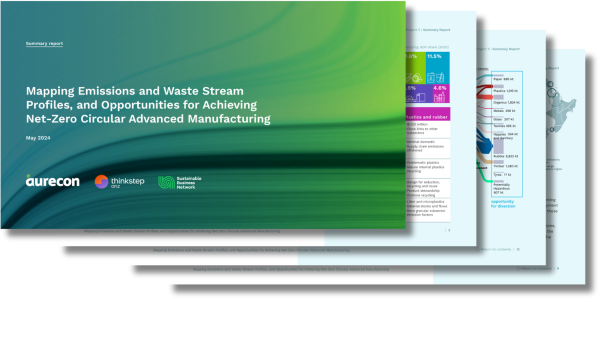
The report Mapping Emissions and Waste Stream Profiles, and Opportunities for Achieving Net-Zero Circular Advanced Manufacturing supports the growth and resilience of Aotearoa New Zealand’s advanced manufacturing sector.
It found that circular economy practices exist in New Zealand within and across manufacturing subsectors. Subsectors differ greatly. However, they are connected through resource flows and face similar challenges, particularly around waste. The report highlights opportunities for each subsector to adopt net-zero practices.
Learn more in the new report delivered by thinkstep-anz, Aurecon and the Sustainable Business Network for the Ministry of Business, Innovation and Employment. Download the summary report here.