The Science Based Targets initiative (SBTi) has released Corporate Net-Zero Standard Version 2.0. For businesses in Australia and New Zealand, this raises practical questions. What has changed? What happens if we already have one? When do the new rules apply? And what should we do now?
The short answer: Corporate Net-Zero 2.0 raises the bar, but it also gives companies a clearer path. It moves the focus from setting a target to showing how the business will deliver it.
What is a science-based target?
A science-based target (SBT) is a greenhouse gas (GHG) emissions reduction target aligned with what the latest climate science says is necessary to limit global warming to 1.5°C above pre-industrial levels.
Why do businesses set SBTs?
Setting an SBT signals environmental responsibility but is also good for business. Customers, investors, lenders and procurement teams increasingly want credible climate claims backed by evidence. A target validated through the SBTi is stronger than a broad net-zero promise, because it follows a recognised framework.
What is Corporate Net-Zero Standard 2.0?
The core idea remains the same: companies need to deeply reduce emissions across their whole carbon inventory before neutralising any residual emissions at the net-zero target date.
This includes emissions they produce directly (scope 1), such as fuel used in company vehicles or equipment. It also includes emissions from purchased energy (scope 2), such as electricity used in offices, factories or stores. And it includes emissions across the value chain (scope 3), such as suppliers, freight, business travel, waste, investments and the use of sold products.
What has changed is the level of detail. The new Standard asks companies to connect their targets with the decisions that shape emissions, including investment, electricity procurement, supplier engagement, product design and operations.
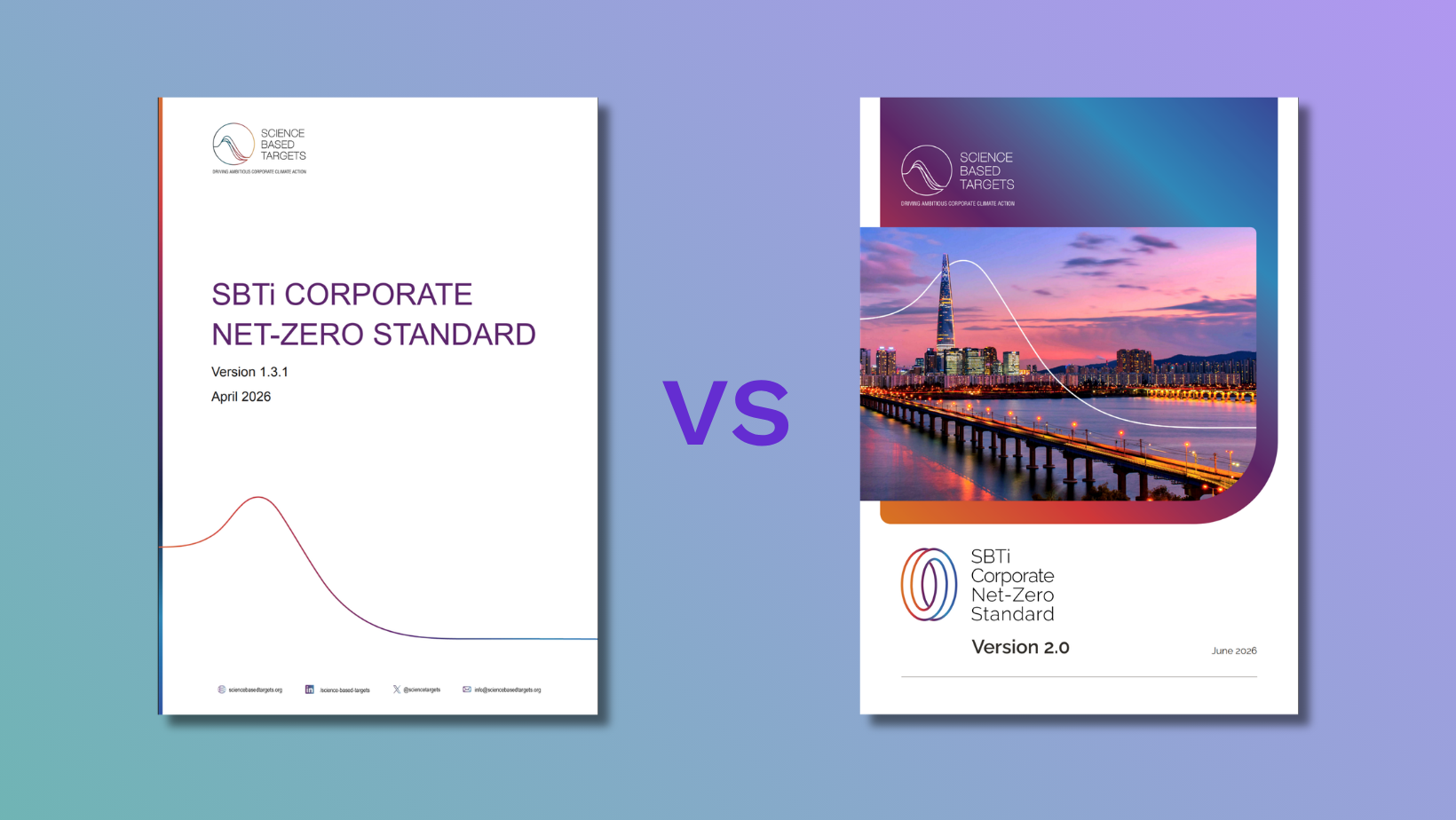
What are the biggest changes?
Different requirements for different companies
The new Standard introduces Category A and Category B companies. Category A generally includes large companies, and medium-sized companies from high-income countries. Category B generally includes small companies, and medium-sized companies from lower-income countries.
Some requirements, including scope 3 targets, assurance and transition plan disclosure, apply to Category A companies but are optional for Category B companies.
Separate targets for different emissions sources
Companies can no longer treat their whole operational footprint as one combined target. Category A companies need separate targets for scope 1, scope 2 and scope 3. Category B companies need separate targets for scope 1 and scope 2.
This creates a clearer picture of where emissions are being reduced. For example, a company cannot rely on progress in purchased electricity to hide slow progress on direct fuel use, company vehicles or owned equipment.
A stronger approach to scope 2
Scope 2 covers purchased energy, such as electricity, heat, steam and cooling. Corporate Net-Zero 2.0 introduces clearer options for scope 2 targets, including targets to reduce scope 2 emissions and targets to increase the use, contracting or matching of low-carbon electricity.
Companies will be required to report both location-based and market-based scope 2 emissions, rather than choosing one method. Location-based reporting reflects the average emissions intensity of the local electricity grid where the company operates. Market-based reporting, on the other hand, accounts for contractual choices such as RECs and power purchase agreements (PPAs).
This means companies can no longer rely solely on buying RECs to claim progress toward their targets. Instead, they must demonstrate genuine emissions reductions by improving energy efficiency in their operations and investing in direct renewable energy generation. Contractual agreements alone will no longer be enough to meet science-based targets.
More focus on scope 3
Scope 3 covers value chain emissions, such as suppliers, freight, business travel, waste, investments and the use of sold products. For many businesses, this is the largest and hardest part of the footprint.
Under Corporate Net-Zero 2.0, Category A companies must set near-term scope 3 targets for significant value chain emissions. The Standard also gives companies more practical options for setting these targets, including supplier alignment, customer alignment and emissions reduction targets.
A transition plan is now part of the target
A science-based target can no longer sit on its own. Companies must develop and maintain a transition plan that explains how they will implement their targets.
This plan needs to cover the actions, timeframes, assumptions, dependencies and governance needed to support delivery.
Five-year target cycles and stronger progress reporting
Corporate Net-Zero 2.0 introduces a clearer cycle of target setting, implementation, reporting and review. Near-term targets cover a five-year period. Companies will also need to report progress and explain any barriers that affect delivery.
This makes target setting less of a one-off exercise and more of an ongoing business process.
What does it mean for businesses with existing targets?
Businesses with existing SBTi targets do not need to start again.
Companies with targets for 2030 or later are advised to keep their current targets and plan to transition to Corporate Net-Zero 2.0 for the next target cycle. Companies setting or updating targets before 2028 can continue to use Corporate Net-Zero Standard Version 1.3.1.
This creates a practical transition period. It also means companies can start using the thinking from Version 2.0 now, even if their next formal submission uses the current Standard.
When does it come into force?
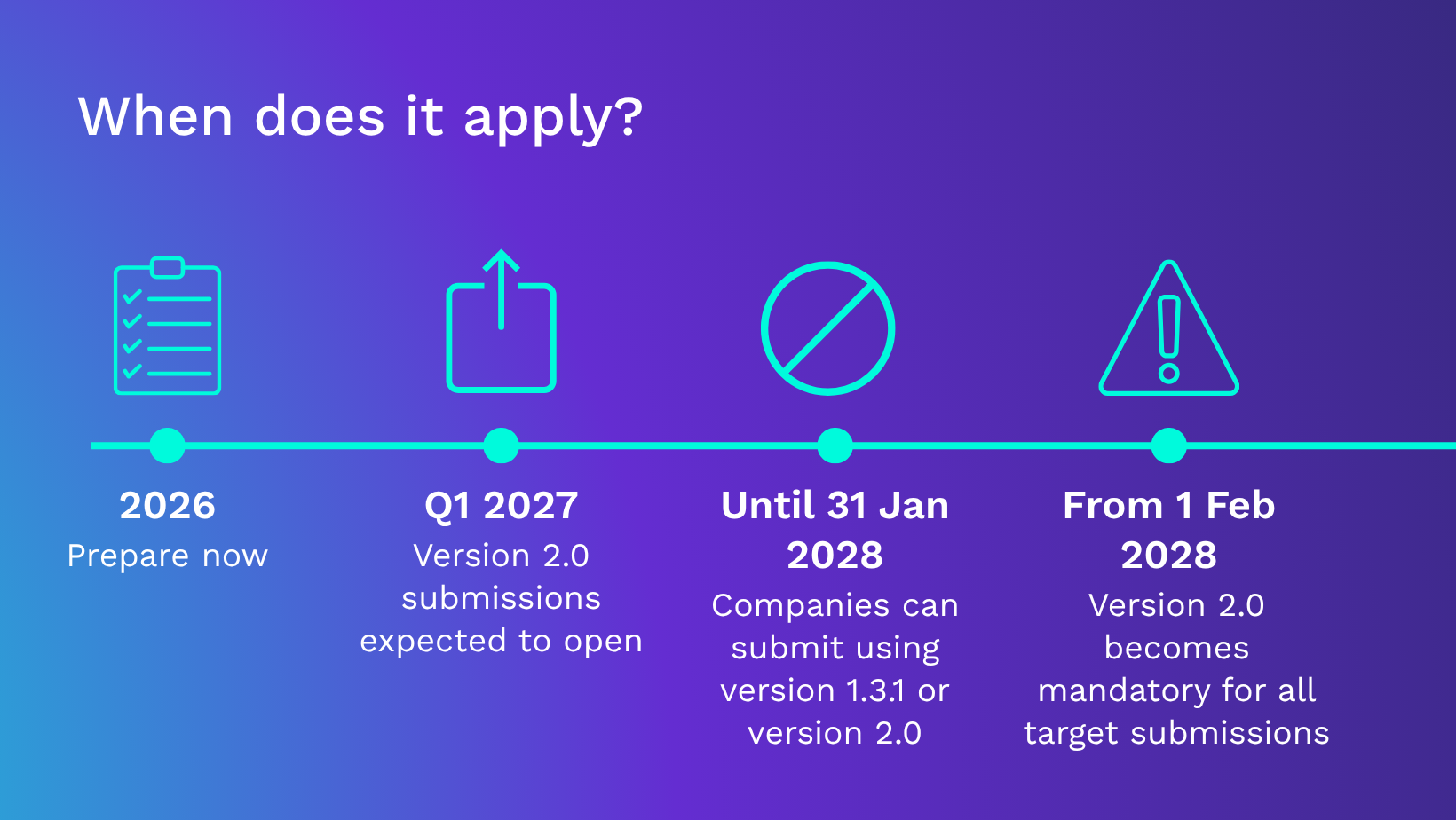
Corporate Net-Zero Standard 2.0 was released in June 2026 and has an effective date of 1 February 2027.
The SBTi Services Validation Portal is expected to open for Version 2.0 target submissions in Q1 2027.
From Q1 2027 until 31 January 2028, companies can submit targets using either Version 1.3.1 or Version 2.0. After 31 January 2028, Version 2.0 becomes mandatory for all target submissions.
In plain English: 2026 and 2027 are the preparation window. From 2028, businesses submitting targets should expect to use the new Standard.
How to get ready for Corporate Net-Zero 2.0
The best preparation is to strengthen the foundations now.
Start by checking where you are in the SBTi cycle. Are you setting a target for the first time, updating an existing target, approaching a five-year review or planning a new cycle from 2028? This will help you decide whether to use Version 1.3.1 during the transition period or prepare directly for Version 2.0.
Next, confirm whether your company is likely to be Category A or Category B. This will shape your scope 3, assurance and disclosure requirements.
Then review your greenhouse gas inventory. Good targets depend on good data. Check whether your scope 1, scope 2 and scope 3 data is current, complete and aligned with the GHG Protocol. For scope 3, identify the categories that matter most and the biggest data gaps. You still need to follow the standard five-year review process and check for any recalculation triggers.
Get your evidence in order too. Be ready to show how emissions were calculated, what data sources were used, what assumptions were made and where estimates or proxies were needed. Plot your emissions year-on-year to show how you are tracking against your target.
If your current target combines scope 1 and scope 2, start looking at them separately. For scope 1, consider reductions through fuel switching, electrification, equipment upgrades, process changes and asset planning. For scope 2, understand your electricity demand, low-carbon electricity options and future growth from electrification.
Most importantly, build a transition plan people can use. A useful plan sets out the actions needed, timing, accountabilities, investment, dependencies, barriers and review process.
For many Australian and New Zealand businesses, supplier and customer engagement will also be essential. Start with the parts of the value chain that drive the most emissions. Ask for better data, understand what partners are already doing and look for practical ways to reduce emissions together.
What should businesses do now?
Do not wait until 2028. If you are working on an SBT, keep going. If you already have one, use this transition period to strengthen your data, improve your transition plan and understand how Version 2.0 may affect your next cycle.
If you have not started yet, now is a good time to build the foundations: a robust greenhouse gas inventory, clear governance and a practical emissions reduction plan.
Corporate Net-Zero 2.0 raises expectations, but it also gives businesses a clearer path. The companies that prepare early will be better placed to set credible targets and manage transition risks.
June 2026