Material use, waste generation and resource recovery are increasingly shaping how organisations manage risk, design products and report performance. Access to virgin materials is becoming more volatile, disclosure expectations are tightening and certification schemes are embedding circular criteria into assessment frameworks. Investors and customers are also asking for clearer evidence that products retain value, use resources efficiently and reduce waste over time.
In this environment, circularity must be measured in a way that is consistent, comparable and credible.
The Global Circularity Protocol (GCP) has been developed by the World Business Council for Sustainable Development (WBCSD) and the United Nations Environment Programme's (UNEP) One Planet Network with input from over 150 experts and organisations to bring structure to this challenge. Launched at COP 20, the framework provides guidance on how organisations can measure, manage and communicate circular performance in a consistent way.
It explicitly aligns with the circular economy standard ISO 59020: Measuring and assessing circularity performance. This alignment is significant because comparability depends on shared terminology, consistent system boundaries and transparent calculation rules. Without this foundation, circularity reporting becomes fragmented and difficult to benchmark across markets.
What many organisations still require, however, is a practical way to generate product-level circularity data that can sit within this structured framework and support decision-making.
This is where the Material Circularity Indicator (MCI) becomes relevant.
The role of the Global Circularity Protocol
The GCP is designed to create consistency in circular economy measurement at organisational level. It supports companies to define circular objectives, measure performance, track improvement over time and communicate results in a comparable way
Its explicit alignment with ISO 59020 strengthens credibility, as the standard sets out how circularity performance should be measured and assessed so that results can be compared across products, sectors and regions
For organisations, the GCP provides the governance and reporting architecture. However, it does not prescribe calculation methods at product level. Businesses still need a way to quantify circularity for specific materials and products in a way that aligns with ISO guidance and can feed into portfolio and corporate reporting. The MCI provides that calculation method.
Comparing circular strategies in practice
Most organisations are already implementing circular initiatives. These may include increasing recycled or renewable content, reducing reliance on virgin materials, designing products for repair and reuse, extending product lifetimes or improving end-of-life recovery.
The difficulty lies in comparing the impact of these strategies in a structured and transparent way.
An organisation may need to understand whether investing in durability delivers greater circular benefit than increasing recycled input, or how a shared-use model affects overall circular performance. At portfolio level, it may need to aggregate product-level improvements into a clear measure of progress.
Without an integrated metric, these decisions rely on separate indicators that do not provide a complete picture
What the Material Circularity Indicator measures
The Material Circularity Indicator, developed by the Ellen MacArthur Foundation, produces a single circularity score between 0% and 100%
It combines three core elements.
- First, it assesses material inputs, examining the proportion of virgin materials compared with recycled, reused or renewable inputs.
- Second, it evaluates material outputs, considering what happens at end of use, including reuse, recycling, remanufacture, composting and unrecoverable waste.
- Third, it incorporates use, or utility, recognising that products which last longer, are used more intensively or achieve the same function with fewer materials reduce demand for new resource extraction and delay waste generation.
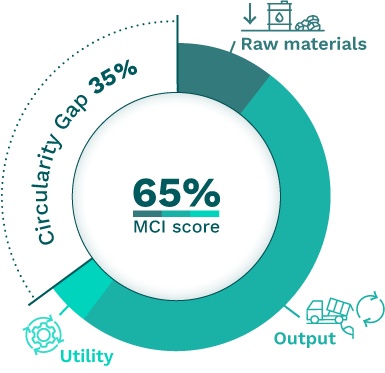
By integrating these dimensions into one percentage, the MCI allows different circular strategies to be assessed within a single framework
A score of 0% represents a fully linear system dependent on virgin materials and generating waste, while a score of 100% represents a fully circular system based on non-virgin inputs and no unrecoverable waste.
For businesses, this supports clearer benchmarking across design options, more consistent procurement criteria, aggregation of results at portfolio level and a stronger basis for circular performance claims.
Strengthening comparability through ISO alignment
The GCP aligns with ISO 59020, and the MCI methodology also aligns with ISO 59020 terminology and expectations. This shared alignment improves transparency and reduces methodological risk.
For organisations operating across multiple jurisdictions or reporting frameworks, this consistency supports comparability and audit readiness. It ensures that product-level calculations can sit within a recognised international measurement framework.
In practical terms, The GCP provides structure. ISO 59020 ensures methodological consistency. The MCI delivers the product-level data required to quantify circular performance.
For organisations embedding circular criteria into procurement, product design or reporting, this combination supports measurable and comparable outcomes.
Evidence of maturity and market adoption
One reason the MCI can effectively support GCP objectives is that it is already in active use across markets and assurance contexts.
Integration in LCA and Digital Product Passport workflows
The MCI methodology is platform independent and has been implemented in a range of tools. It can be calculated in spreadsheet-based tools such as thinkstep-anz’s MCI Pro and it has also been integrated into leading Life Cycle Assessment (LCA) and Digital Product Passport (DPP) workflows, including . This allows circularity results to be generated alongside environmental impact modelling, rather than as a separate process.
This reduces cost and complexity. It also avoids vendor lock-in, because the MCI is not confined to a single platform. Results generated in different tools can be compared more easily.
Referenced in recognised certification schemes
Built environment schemes aligned with ISO 59020, including Green Star Buildings v1.1 and BREEAM, reference the same indicators used in the MCI In material-intensive sectors, this demonstrates that the methodology is robust enough for structured, independently assessed frameworks.
Published in verified Environmental Product Declarations
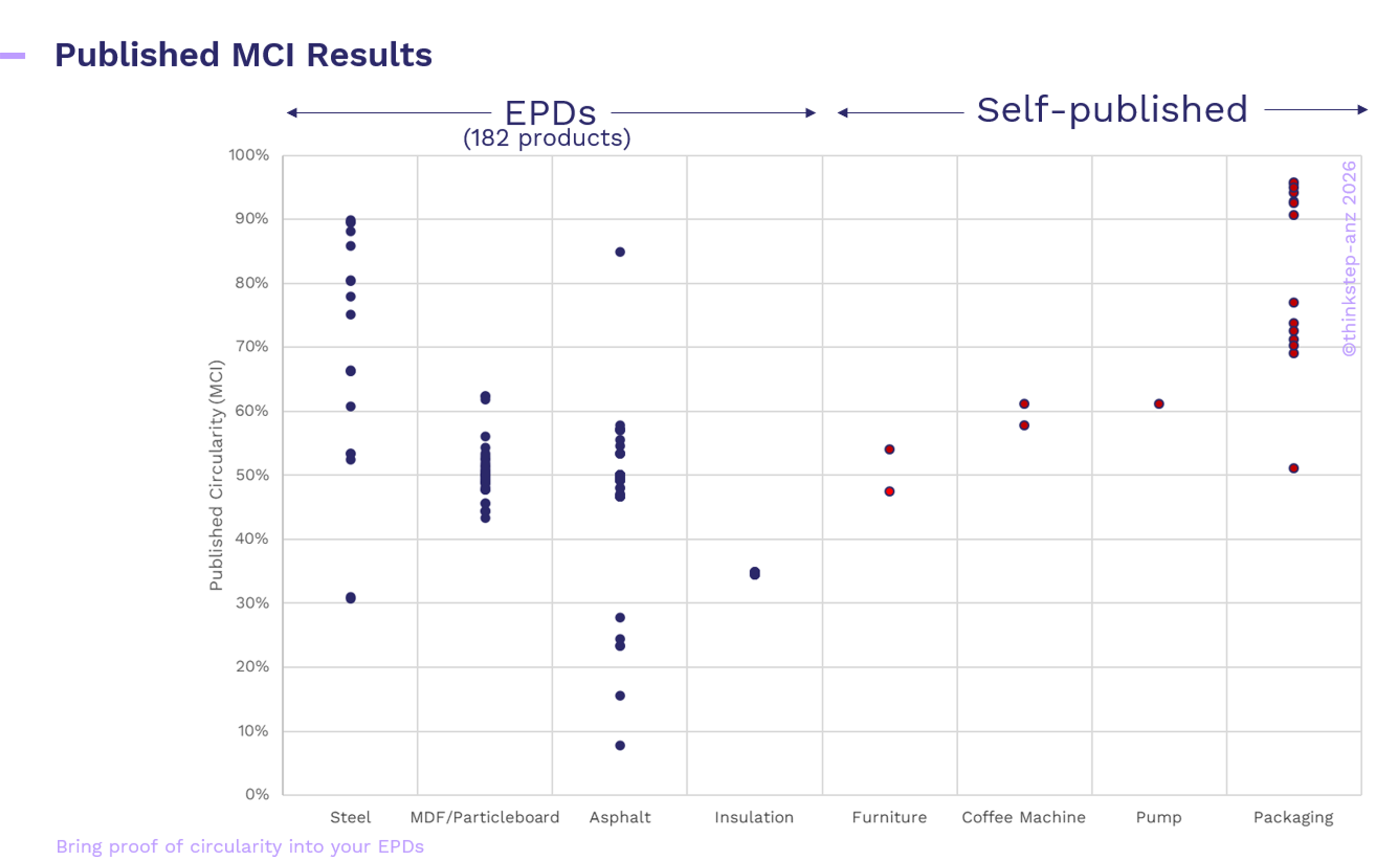
MCI results are increasingly included in EPDs published by EPD Australasia. As of March 2026, there were MCI in EPDs for more than 180 products. Embedding circularity metrics within established, independently verified reporting systems strengthens credibility, comparability and market trust.
Usable beyond specialist sustainability teams
The MCI can also be applied earlier in product development to screen design options before sourcing decisions are finalised. Calculators, including those published by thinkstep-anz, allow teams to test circular strategies when design changes are still commercially viable.
Together, these signals show that the MCI is not a theoretical framework. It is already embedded in tools, certification schemes and reporting processes that businesses rely on.
A practical advantage: circularity as a living metric
Circular performance does not stop at the factory gate. It depends on how products are used, maintained and recovered.
The MCI can be broken down into components, including material Inputs, material outputs utility and the circularity gap. This allows performance to be updated as data becomes available.
For asset-intensive sectors, infrastructure projects and long-lived equipment, this flexibility matters. It supports accountability across the value chain and reflects shared responsibility between producers and operators.
It also aligns closely with the GCP’s objective of enabling ongoing performance management rather than static one-off declarations.
Ready to strengthen your circularity measurement?
If your organisation needs decision-grade circularity metrics, high-level frameworks are not enough. We have developed the MCI Pro, a tool that delivers:
- Full ISO 59020-aligned outputs
- Scenario modelling to support design and sourcing decisions
- Verification-ready circularity declarations aligned with ISO 59040
- Integration alongside LCA and EPD workflows
It is designed for organisations that require defensible, comparable and audit-ready circularity data.
If you are embedding circular criteria into product development, procurement or reporting, MCI Pro provides the practical measurement foundation to support it. Get started here.