Environmental claims are facing increasing scrutiny. In recent years, greenwashing has been a growing concern for regulators in Australia, New Zealand and many other parts of the world who are working to protect consumers and maintain market integrity.
The latest report on greenwashing by the Australian Securities and Investments Commission (ASIC), released in August 2024, highlights several cases where companies faced penalties for exaggerated or misleading claims about their environmental impact.
For example, in one high-profile case, Mercer Superannuation was fined $11.3 million after ASIC found inconsistencies between its claims of environmentally friendly investments and the actual portfolio, which included coal companies and other high-emission industries.
ASIC's greenwashing interventions from April 2023 to June 2024 include issuing eight infringement notices and securing 37 corrective disclosures. Misleading sustainability claims without reasonable grounds—such as claiming carbon neutrality without a verified plan—are common pitfalls. Ignorance or unintentional greenwash are no defence.
For businesses, this means two things: the need for vigilance and an opportunity to stand out with credible, transparent practices and communication.
How big is the problem?
Regulators are taking a tough stance on greenwashing, as recent actions show. In Australia, the Australian Competition and Consumer Commission (ACCC) reviewed sustainability claims from 247 brands in 2022 and found that 57% were potentially misleading. The issues ranged from vague claims to absolute terms like “100% recyclable” or “zero emissions” that weren't backed by clear evidence. The ACCC has since signalled targeted assessments on some companies, indicating potential breaches of Australian Consumer Law.
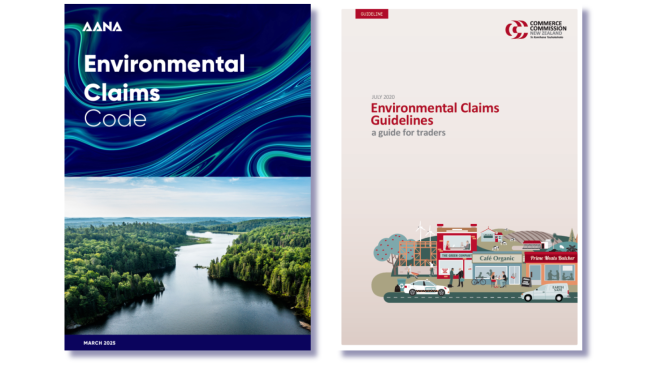
The Australian Association of National Advertisers (AANA) recently released a new Environmental Claims Code which takes effect 01 March 2025. This code requires advertisers to avoid broad, unqualified statements and mandates that all claims need to be supported by data.
In New Zealand, the Commerce Commission released its own Environmental Claims Guidelines in 2020. These guidelines cover claims around product composition (like “recycled content” or “organic”), production (such as “made with renewable energy”), and recovery (like “biodegradable” or “recyclable”). With these guidelines, companies are expected to back up claims across their product’s life cycle carefully.
How to avoid greenwash: Eight principles for trustworthy claims
In 2023, ACCC released Making Environmental Claims: A Guide for Business, outlining eight key principles for creating best practice environmental claims:
- Make accurate and truthful claims: Consider the overall impression, and only make claims that represent a genuine environmental impact.
- Have evidence to back up your claims: Independent, scientific evidence is the most credible.
- Don’t hide important information: Avoid footnotes and small print where consumers are unlikely to find or notice it. Know your product's entire life cycle so you know the full picture and be transparent about it.
- Explain any conditions: If specific consumer behaviour is required to achieve the claimed benefit, say so.
- Avoid broad, unqualified claims: Be clear and specific. Include prominent disclaimers if claims need to be qualified.
- Use clear language: Stay away from technical jargon and make it easy to understand.
- Ensure visuals don’t mislead: Avoid using symbols like recycling symbols if relevant services aren’t widely available or nature-based colours or visuals if they give the wrong impression.
- Be transparent about your sustainability journey: Acknowledge the challenges in reaching your goals and be direct and open about your plans.
Why good claims are worth it
When done right, environmental claims enhance credibility with customers, investors, and the wider community. Some organisations, however, are so wary of greenwashing that they avoid environmental claims altogether – a phenomenon called “greenhushing.” While understandable, greenhushing can work against both the business and the broader environmental movement.
Three good reasons to embrace trustworthy environmental claims:
- A brand boost: Sustainability stories elevate your brand and build loyalty.
- Become a product of choice: Your customers can rely on your data and compare your product to others.
- Industry standards: Collective action is essential. Lead by example and inspire others to follow with your success stories.
Steps to build credible environmental claims
To avoid the pitfalls of greenwashing while boosting your reputation, consider these steps:
- Review your claims: We can help do this with experienced, fresh eyes.
- Modify or remove weak claims: Act now if any claim doesn’t meet the ACCC’s or Commerce Commission’s guidelines.
- Quantify with metrics: Measure the impact of your organisation, services or product, for example, carbon footprint, recycled content, and life cycle data to ensure evidence for claims is available.
- Align with standards: For climate-related claims, for example, follow the AASB guidelines in Australia and XRB guidelines in New Zealand.
- Create a policy: Develop internal guidelines on environmental claims, and communicate them to staff, suppliers, and marketing partners via formal and regular training.
- Avoid greenhushing: Be transparent and share your sustainability achievements, building trust and setting a positive example for the industry.
Would you like tailored advice on building credible sustainability claims? Get in touch with our experts today for a greenwashing risk review.