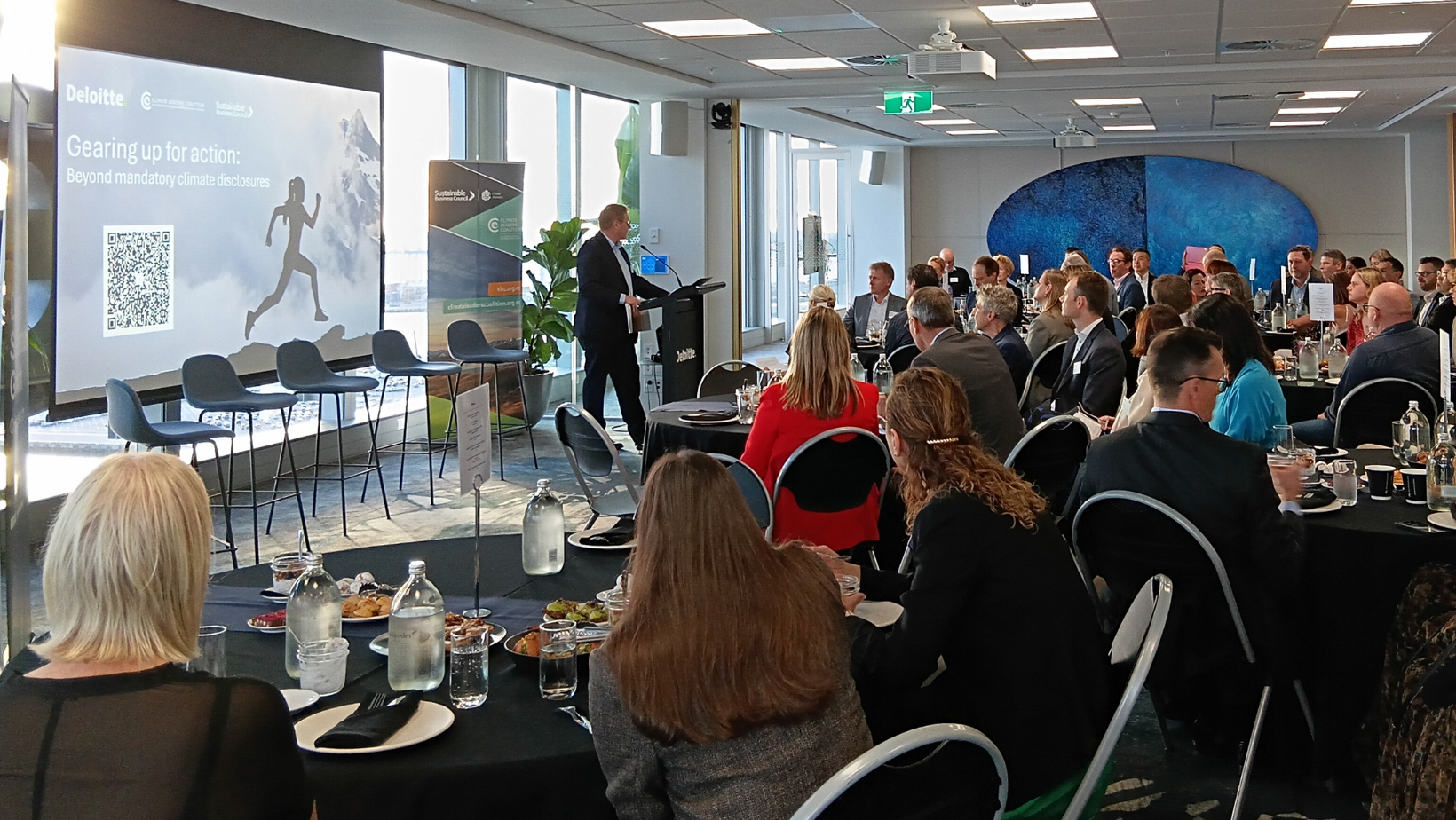
‘The customer is the new regulator’ was the message that stood out at a recent breakfast hosted by the Climate Leaders Coalition, the Sustainable Business Council (SBC) New Zealand and Deloitte.
The event marked the release of the report Gearing up for action: Beyond mandatory climate disclosures, designed to support organisations leaving New Zealand’s mandatory climate-related disclosures regime, as well as other voluntary reporters who are preparing practical and credible disclosures.
The conversation brought together business leaders from across Aotearoa New Zealand to discuss what comes next for climate reporting, climate action and business resilience. For Barbara and Matthias, the strongest takeaway was that climate disclosure is no longer just about compliance. It is becoming a core part of business strategy, investment and decision-making.
Do not lose momentum
Rikki Stancich from Deloitte opened with a strong reminder: do not lose the progress already made. The opportunity now is to build on that momentum and turn climate disclosure into action, especially in a country so dependent on natural capital.
As Mike Burrell, Chief Executive of the SBC, put it: ‘Climate disclosure is no longer compliance. It is business leadership and resilience.’
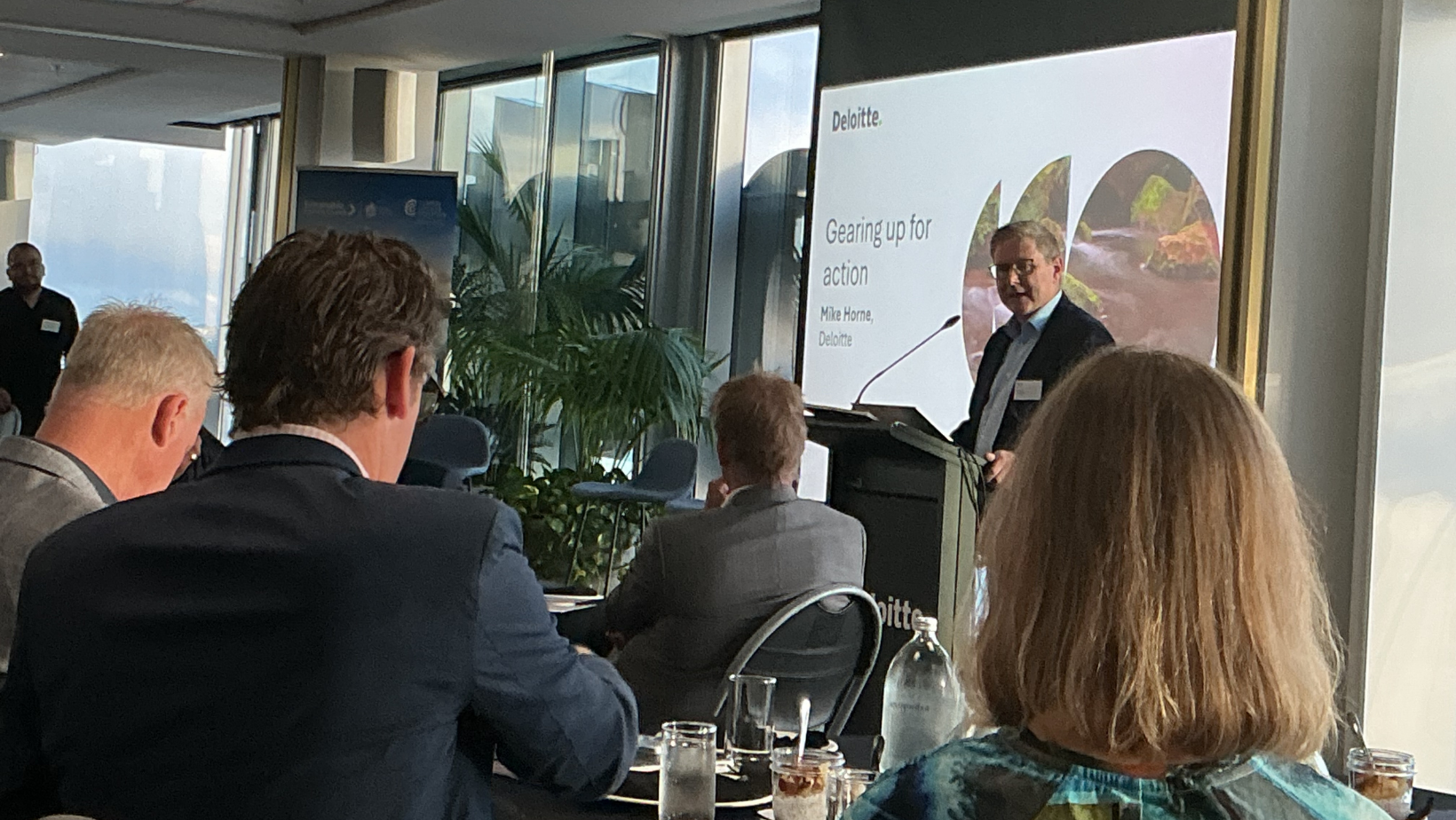
And while regulation may be shifting, expectations are not. Mike Horne, Chief Executive of Deloitte New Zealand, summed this up clearly: ‘The mandate has narrowed, but the market has not.’
The focus is shifting to execution
The conversation has moved on from ambition to implementation. ‘The challenge is no longer ambition – it is execution at speed and scale,’ said Mike Burrell.
Mike Horne added another clear challenge for leaders: ‘Waiting for certainty is a strategy that will fail. Choose to lead.’
In other words, uncertainty is not a reason to pause. It is the environment organisations now need to operate in.
Climate action is a commercial reality
What stood out strongly for Barbara and Matthias was that climate action is now firmly a commercial issue, not only a sustainability one.
Mike Horne highlighted that ‘climate action creates business advantage – lower cost, access to markets, access to capital and reduced supply chain risk.’
Rebecca Mills, founder of The Lever Room, brought this back to the bottom line: ‘Carbon is cost and cost is carbon.’
The real value is not in reporting itself, but in using it to identify risks early, make better decisions and unlock business value.
Customers are setting expectations
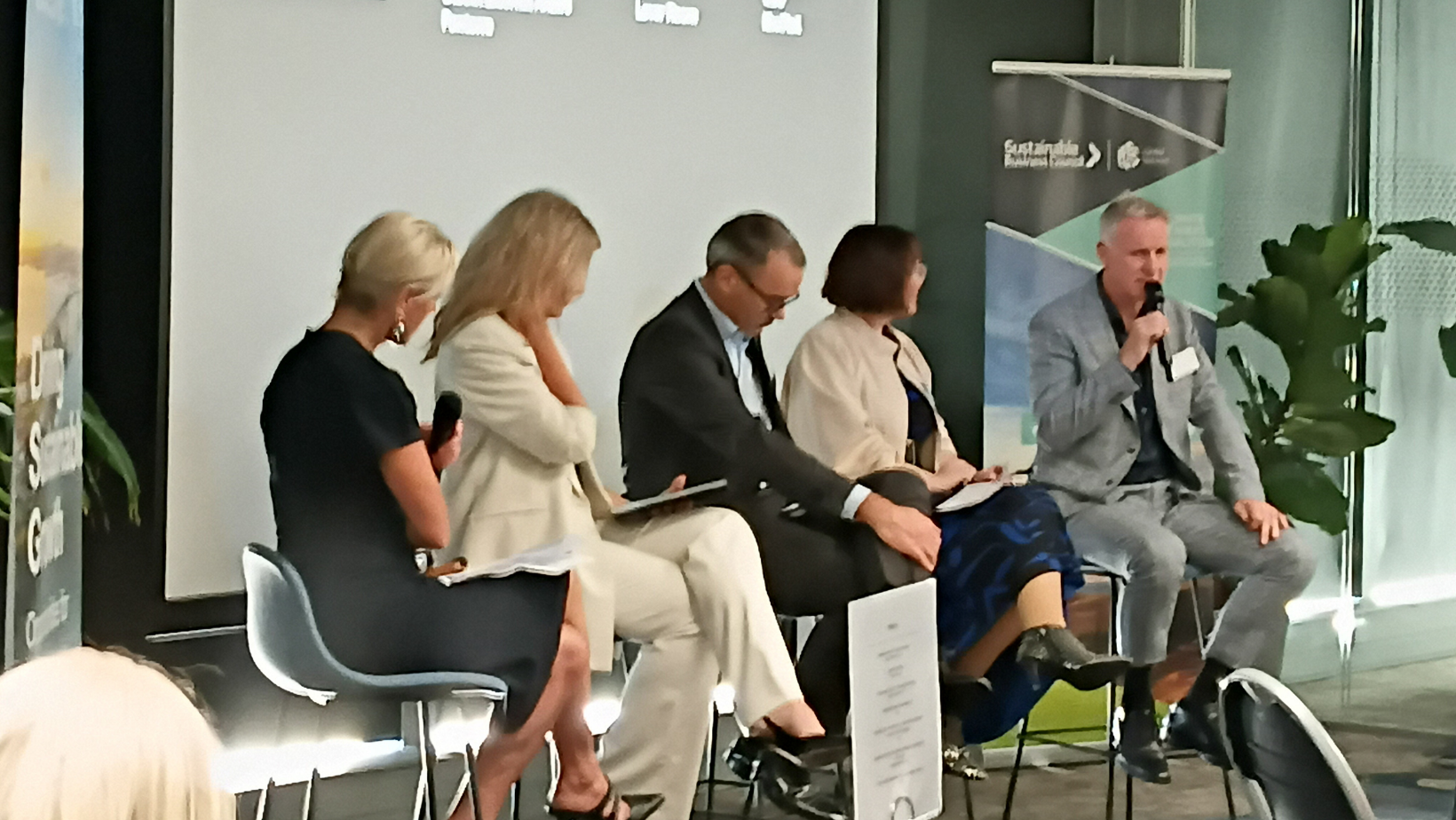
Simon Tucker, Director of Global Sustainability, Stakeholder Affairs and Trade at Fonterra, captured a major shift in one line: ‘The customer is the new regulator.’
While regulatory settings may change, global customers are not stepping back. They continue to ask for credible emissions data, transition plans and evidence of progress.
Simon also described the challenge many organisations now face as an ‘energy trilemma’ – cost, carbon and availability. Targets may remain, but the pathway to achieving them will need to evolve.
Resilience needs systems thinking
Physical risk and resilience were also strong themes.
Peter Reidy, Chief Executive of KiwiRail and a Climate Leaders Coalition Steering Group member, warned: ‘We are one event away from being uninsurable.’
For infrastructure, transport and other long-term assets, climate risk is already shaping investment decisions. As Peter noted, ‘reporting gives you the evidence to invest.’
He also stressed the need for collaboration: ‘We need system thinking and collaboration.’ Electrifying ferries, for example, only works if shore power and the wider energy system are ready. These challenges sit across sectors and cannot be solved in isolation.
Reporting creates a single source of truth
Nikki Wright, Managing Director of Wright Communications, highlighted the internal value of reporting: ‘A report can bring all parts of a business together around a single source of truth.’
That matters because turning strategy into action requires alignment across teams, data, governance and decision making.
The discussion also included practical examples, such as Toyota seeing strong returns from installing solar on a warehouse roof, significantly reducing electricity costs with a five-year payback period.
A final reminder from Louise Aitken from Deloitte brought the investment lens into focus: ‘If you are not reporting, you are invisible to the investment community.’
Looking beyond the mandate
Barbara and Matthias left the breakfast with a clear sense that a shift is underway.
There is less focus on ambition alone and more focus on execution. Less focus on reporting as an endpoint and more focus on using it as a tool for decision making, resilience and competitive advantage.
Encouragingly, many organisations are not stepping back despite regulatory changes. If anything, they are leaning in because the underlying risks and opportunities are becoming more tangible.
Need support with voluntary climate reporting? Our disclosurekit helps organisations decide what to disclose, structure their reporting and keep momentum going beyond the mandate. Get in touch with thinkstep-anz to find out how we can help.