From picking up rubbish in the school yard to becoming a co-founder of the African Circular Economy Network (ACEN) – thinkstep-anz’s Senior Circular Economy and Strategy Specialist Sally-Anne Käsner always had a strange fascination with waste. We talked with her about why the circular economy has become such an attractive proposition for businesses and what we can learn from the African continent.
Tell me a little about how you got started in the sustainability field.
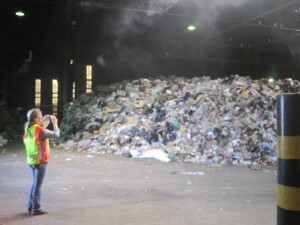 Growing up I had a fascination with waste and how we got rid of things. After break at school, I was always the one picking up other people’s stuff. That grew into environmental awareness. Eventually I ended up doing my Master’s in waste recycling.
I wanted to have a meaningful impact, so I got more into resource efficiency and cleaner production. That’s where my passion grew for designing waste out. When circular economy as a term came about, I thought ‘right, now we have a word for it’.
So, it’s not new?
No, the concept has been around at least since the 1960s. But it’s been spoken about in different ways: industrial ecology, urban metabolism, Cradle to Cradle. All mean being regenerative, being resilient, designing systems differently. The linear system is broken, and it’s because we designed waste into the system.
Why the delay in uptake of circular economy principles?
Because this is the first time that the explanation and the concept include the economy as the driving factor, making the link for industry and business clearer. It’s saying that by redesigning our system, we can build in resilience and abundance. It is an important shift away from the ‘green’ narrative which may seem an abstract term and only for certain organisations who have the means to implement. The circular economy aims to be inclusive and even small initiatives can have impact.
Having worked in several different industries what common opportunity do you see?
Well, there’s a race to the top in sustainability and circular economy now. Circular economy to companies often means a recycling strategy. But recycling isn’t the same as circular economy. It’s almost a dirty word sometimes!
 Instead, I see a big opportunity in revisiting the ways we used to deliver products. The reuse/refill scenario. Take the ‘milkman’ model: many moons ago milk could be delivered to your door in a glass bottle. You’d leave tokens, your bottle would be swapped out, and you’d receive milk. Why can’t we have reusable, refillable bottles again? Think of the work opportunities that can be created through a more service-oriented model? That’s why recycling isn’t the first port of call for me at all.
It seems a little silly that one of the solutions is something we did 40 or 50 years ago…
It does! When you look back, there were adverts in the 1950s training housewives to throw away stuff because they weren’t used to doing that! They had adverts saying ‘Ladies, you never have to wash a dish again. Just go on a picnic and throw it away.’ For me, if we can train it in, we can train it out, except this time to all consumers. We just need to get through industry and some of the models we seem to be locked into. We need to find alternative models to just selling more units and increased consumerism.
What are the main challenges involved in making circular economy happen?
 It’s such a different way of thinking that it’s not going to happen overnight. The best opportunity is when you have a greenfields project. For example, in Cape Town I worked with a hotel that wanted to be the greenest hotel in Africa. The owner gave us a blank slate to design a waste management plan. We told him that to be the greenest hotel he’d need to eliminate waste altogether. He didn’t understand what we were talking about! This thinking was way ahead of the game. Nonetheless, we worked with the owner and the staff to design out waste right from the beginning. In the guest rooms we swapped out milk cartons for a pop lid bottle that was refillable. We did that with all the guest amenities. For food on site, we looked at how locally we could source it.
If you have someone at the top say ‘This is what we’re doing, I don’t have all the answers, but we have to achieve this by year x’ then the results can be quite amazing.
You’re a co-founder of the African Circular Economy Network (ACEN). What’s your experience of promoting circular economy around the continent?
One of the reasons we set up the network was because representatives from developed economies were coming into Africa saying, ‘We have the solutions, this is how you do circular economy’. We decided we have to speak up because our context is completely different. In certain instances, we’re fairly circular already and could leapfrog some of the systems in place in more developed economies.
We now have about 100 representatives around the continent. Rwanda is one of the first countries to ban plastic bags. Kenya followed shortly after. There are some farming practices in Africa that have always been regenerative.
How do you manage the ideas of such diverse voices?
It is tricky but we’re also all in a similar transition. Countries like Ghana and Nigeria have booming economies, rapid urbanisation and very little in terms of waste management infrastructure. Most of Africa is still based on an extractive economy. We need to rethink these models.
Diversity is our strength. We’re starting to speak to people in different countries. With South Africa being part of the Global South, I’m excited to see how ideas can be shared between Australia and New Zealand, including around indigenous knowledge.
In your opinion, how can we move further into regeneration?
For me, waste has always been the indicator of a broken system. We need to rethink our natural systems – which includes our built environment. We often bring resources to our cities and towns from far away. We need to ask; how do we grow our food and use our water differently? Start with organic cycles and linking food and food waste back to the building of our soils. Good soil holds more water, which is important for water scarce countries like South Africa and Australia. Circular economy is about thinking in a system rather than different sectors. If we think in a system, regeneration comes naturally.
What do you most look forward to with your upcoming move to Australia?
 We visited Australia in 2011 and travelled from Melbourne to Cairns. I’m really looking forward to the diversity of places you can go. We love camping so going off-grid and camping at a beach somewhere would be amazing. I’m looking forward to having an adventure!
Tell me a little about your passions outside of work.
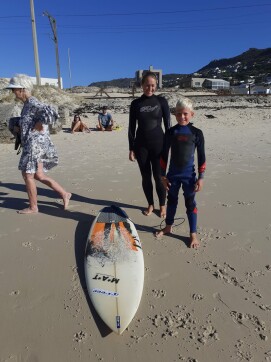
I used to do a lot of diving and trail running. Now I’ve got two boys who drive the passions. We spend a lot of time at the beach and they’re really getting into surfing, which is great! Just being outdoors, away from the crowd – that’s where we feel happy.