Organisations are increasingly expected to demonstrate circularity in the products they specify and procure. Yet many circular economy claims remain difficult to compare.
One manufacturer highlights 30% recycled content. Another emphasises recyclability at end of life. A third points to a long design life. Each claim can be valid, but they describe only part of the picture.
For procurement teams, designers and asset owners, the challenge is understanding how these factors combine and which product is actually more circular.
The Material Circularity Indicator (MCI) was developed to address this problem. Created by the Ellen MacArthur Foundation and aligned with ISO 59020, the MCI brings multiple aspects of circular performance together into a single comparable score. It is increasingly used as a verified metric for product circularity across industries.
What is the MCI, and why does it matter?
The MCI is expressed as a percentage score ranging from 0% to 100%. A score of 0% represents a completely linear product made entirely from virgin non-renewable materials that ultimately become waste. A score of 100% represents a fully circular product that uses no virgin inputs, produces no waste and is used as efficiently as possible over its lifetime.
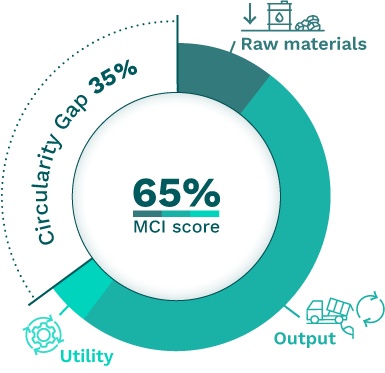
Most real-world products sit somewhere in between, and that’s exactly the point. The MCI doesn’t reward perfection; it gives you a clear, honest picture of where a product sits on the circularity spectrum right now and where the gaps are.
To calculate the score, the MCI considers three factors together:
- Inputs: where the materials come from
- Outputs: what happens to materials at end of life
- Utility: how effectively the product is used during its lifetime
This last factor is often overlooked in simpler metrics. A product that lasts twice as long or is shared between two users effectively halves its material footprint. And the MCI captures that.
The MCI in Environmental Product Declarations: putting circularity on the label
One of the most important developments in recent years is the inclusion of the MCI in Environmental Product Declarations (EPDs).
EPDs function much like a nutritional label for products. They are independently verified documents that disclose environmental impacts across a product’s lifecycle and follow strict rules so results can be compared fairly.
Traditionally, EPDs have focused on carbon and other environmental impacts. As circular economy commitments become more central to sustainability strategies, there is growing demand for EPDs to communicate circularity as well. The MCI provides a consistent way to do this.
Including a verified MCI score in an EPD allows manufacturers to present circularity data alongside carbon data in a standardised and independently verified format. For specifiers and procurement teams, this provides a reliable basis for comparison.
In Australia and New Zealand, adoption is increasing. A growing number of building product EPDs now include MCI scores. The Green Star rating system incorporates the MCI in version 1.1 of its criteria, and the Infrastructure Sustainability Council recognises it within its ratings framework.
The MCI and digital product passports: a natural fit
The MCI is also well positioned to support digital product passports (DPPs), which are gaining momentum in European regulation and supply chain transparency initiatives.
A digital product passport is a digital record that travels with a product throughout its lifecycle. It contains information about materials, manufacturing, use and end-of-life pathways so stakeholders across the value chain understand how the product should be managed.
The MCI aligns well with this concept because it can be updated over time. Manufacturers initially declare a score based on expected use and recovery pathways, but the score can be revised as real-world data becomes available.
Material inputs remain fixed at manufacture, while use and recovery information can evolve. This makes the MCI a useful metric within digital product passport systems.
A metric built for comparison
One of the most valuable features of the MCI is that it enables direct comparison. Because it uses a consistent methodology and produces a single score, products can be assessed side by side.
This can reveal trade-offs that simpler metrics miss. A product with high recycled content may still perform poorly if it has a short service life or limited recovery options. Conversely, a product made from virgin materials may achieve a higher circularity score if it is designed for long-term use, reuse or remanufacturing.
For procurement teams, this creates a practical decision-making tool. Organisations can request MCI scores from suppliers and compare products on a consistent basis.
The MCI also highlights the circularity gap, the difference between a product’s current score and 100%, helping identify where improvements will have the greatest impact
A living metric that evolves with the product
Another important feature of the MCI is that it can function as a living metric.
At the point of manufacture, producers know the material composition of their products but can only estimate how long they will remain in service or how they will be recovered at end of life. These assumptions are based on typical use patterns, infrastructure and design features such as repairability or disassembly.
The MCI framework allows these assumptions to be updated as better information becomes available. If a product lasts longer than expected or improved recycling systems increase recovery, the score can increase. If products are removed early or sent to landfill, the score reflects that outcome.
Material composition data remains with the manufacturer, while downstream users can update use and recovery information without accessing commercially sensitive details.
Built into your existing processes
The MCI lies in how it can be applied within existing product design, specification and procurement processes. To make the methodology practical to apply, we developed MCI Pro – an Excel-based calculator that simplifies the process of calculating circularity. By entering a product’s bill of materials, expected service life and end-of-life recovery assumptions, manufacturers, designers and procurement teams can generate a robust MCI score and test how different design choices or material options influence circular performance.
While particularly valuable during product design, the tool can also be applied to existing products. This allows organisations to benchmark circularity across product portfolios, identify improvement opportunities and track progress over time.
Developed for non-LCA specialists such as designers, engineers and procurement teams, MCI Pro makes it easier to integrate circularity into product development and sourcing decisions without requiring complex life cycle modelling. The tool can also generate circularity declarations, including a verification-ready declaration and a machine-readable Product Circularity Data Sheet (PCDS) aligned with ISO 59040. This enables structured circularity data for digital product passports or standalone declarations, even where a full life cycle assessment or Environmental Product Declaration (EPD) is not required.
For organisations already conducting life cycle assessments, the MCI methodology is also integrated into major LCA platforms, allowing circularity to be assessed alongside environmental impact indicators using the same underlying data.
The bottom line
The circular economy is moving beyond slogans and into measurable frameworks. Regulators, rating systems and procurement processes increasingly require verified and comparable evidence of circularity.
The MCI provides a transparent score that captures a product’s circularity, from raw material sourcing through to end-of-life recovery. For organisations specifying products or managing assets, it creates a common language that makes circularity comparable across the supply chain.
It also creates opportunities at the project level. Because the MCI can be updated to reflect how a product is used, maintained or recovered, project teams can adjust the score to reflect their own circular strategies. The circularity of a project is therefore not simply the sum of the products specified.
Organisations that can generate credible circularity data will be better positioned to compare products, improve design decisions and demonstrate measurable progress.
To learn more about how MCI Pro can help teams assess circularity earlier in design and procurement, get in touch today.